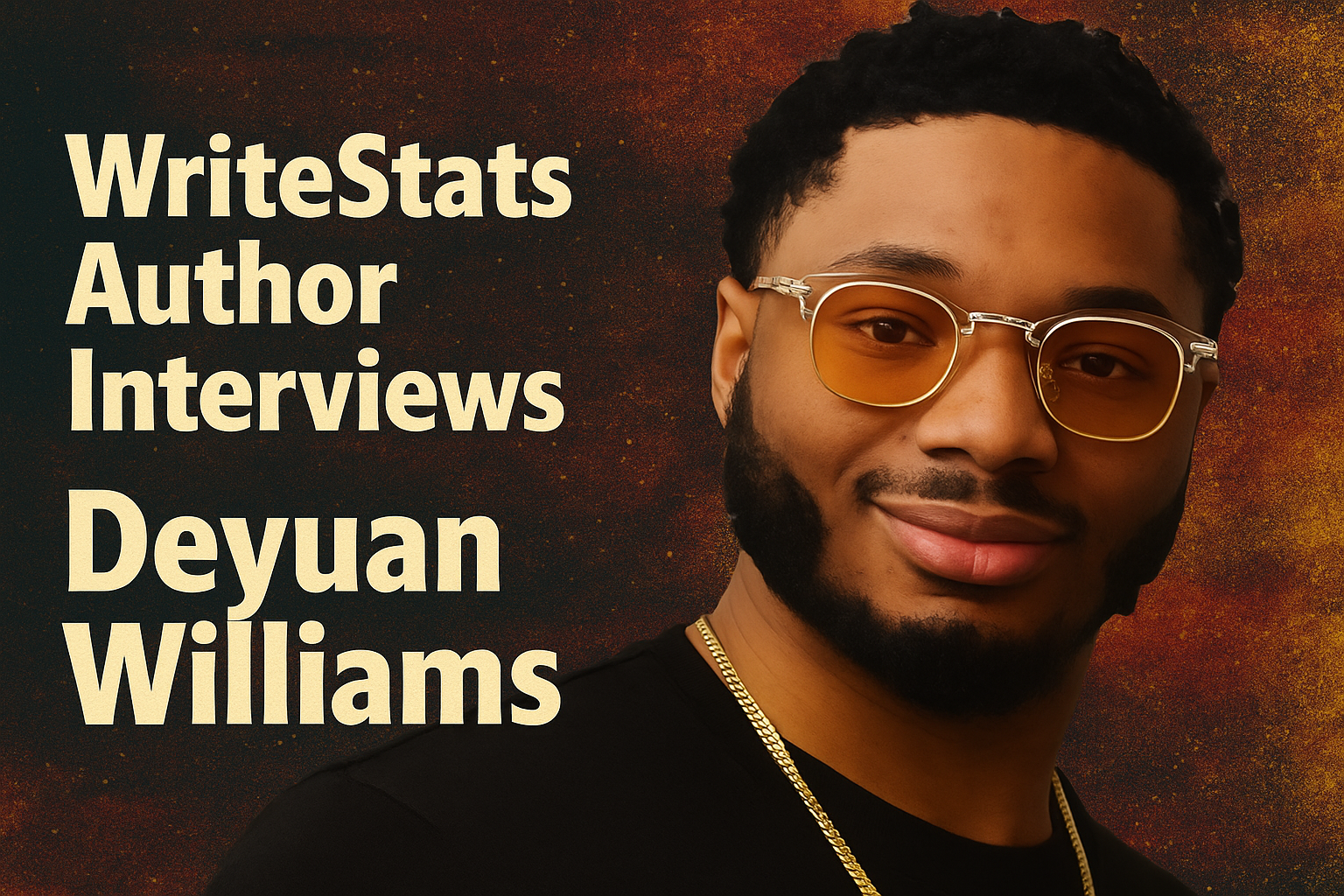
In today’s WriteStats Author Interview Series, we look at the creative evolution of Deyuan Williams, an emerging voice in dark, thought-provoking fiction whose work explores ruin, legacy, and the inner fractures of humanity. Williams is the author of three books:
Together, these works reveal a writer drawn to the shadows, stories where psychological depth meets high emotional stakes.
Born in 1998 and based in the United States, Williams is part of a rising generation of indie authors reshaping how dark fantasy and speculative fiction reach readers. His creative arc reflects what we’ve seen across the industry: authors who build entire worlds long before they put words on the page, and whose passion for story outweighs commercial expectations.
This interview uncovers how Williams writes, why he publishes the way he does, and how he’s preparing his universe for its next evolution.
A Story That Followed Him for 13 Years
Some authors plan their writing careers. Others, like Deyuan Williams, are followed by a story until it demands to be written.
He recalls the moment it began:
“I had my first spark of a story when I was fourteen… I held it in my head for years before I finally sat down at twenty-seven and put those first words on paper.”
That long gestation period shaped not only the story but the writer himself. Williams didn’t rush into writing; he waited until skill, confidence, and timing aligned. When the idea finally became a manuscript, “that moment changed everything.”
For many writers, this is a familiar pattern. A story burrows deep, evolves quietly, and only surfaces when the author is ready. Williams’ experience reflects the creative persistence seen in countless indie authors forging their path.
The Support System Behind the Stories
While some authors work entirely alone, Williams openly credits one central influence:
“My wife is one of my biggest [influences]. She’s the one who tells me when an idea doesn’t land… and who reminds me that some stories deserve happier endings.”
She is both a creative sounding board and an emotional anchor, critical in crafting dark fiction that still retains emotional resonance.
This blend of support and challenge helps Williams refine his voice, ensuring each new book is sharper than the last.
Writing for Connection, Not Numbers
Many writers struggle with metrics—sales, likes, reviews—but Williams has deliberately shifted his focus. He explains:
“What motivates me to keep writing… is learning to stop chasing the numbers. Instead, I focus on the connections my stories create.”
He describes the unmatched feeling of hearing from a reader who connected with his work:
“When a stranger reaches out… it reminds me why I started.”
This mindset aligns strongly with the findings from our WriteStats escape-reading study, where 47% of readers read to escape, not for literary prestige, not for trendiness, but for emotional connection. Writers like Williams tap directly into that audience by centering the experience rather than the metrics.
A Simple, Flexible Writing Process
In an era of complex software ecosystems, Williams keeps things refreshingly minimal:
“Google Docs is where most of my stories live… my Notes app catches ideas… Canva helps me bring the world of my books to life with visuals.”
This lightweight toolkit mirrors his philosophy: stay flexible, stay present, and focus on storytelling over tools. It’s a reminder that a strong writing system doesn’t have to be complicated; it just has to work.
Why He Chose Amazon and Why It Works for Him
Williams’ publishing decisions reflect another major trend in modern indie publishing:
“I chose Amazon because it gave me everything I needed… simple upload process, full control, and global reach from day one.”
He relies on Kindle Unlimited, promotional tools, and analytics to understand his readers, leveraging the ecosystem rather than fighting it.
His preparation process also highlights the importance of professional support:
“Having an editor made the biggest difference… they helped shape the final draft and tighten the story.”
This balanced mix of self-management + targeted outsourcing is precisely the model used by the most successful indie authors today.
The Reality of Marketing: The Hardest Part
Williams is candid about the most significant challenge he faces:
“The biggest challenge I face as a writer is marketing. It really does suck sometimes… Writing is the easy part.”
He continues:
“I take it one step at a time… every post, every conversation, every reader connection slowly builds the audience.”
This slow-growth strategy reflects industry data: indie authors succeed most often when they play the long game, build communities gradually, and nurture direct relationships with readers.
His Perspective on AI: Tool, Not Replacement
Unlike some authors skeptical of AI, Williams takes a pragmatic stance:
“I think AI tools… are just another part of the world we live in now… As long as the AI is not writing the story for you… it can be helpful.”
This aligns with the hybrid-workflow trend we’ve documented: authors using AI for structure, polish, and admin but preserving their voice as the creative core.
What He Hopes His Writing Leaves Behind
Legacy is central to Williams’ motivation:
“I want people to feel something… I want my characters to stay with readers in a way they never forget.”
He sees writing not as a career yet, but as a conduit, an emotional bridge that connects him to readers across distance and time.
What’s Next: Four Books in Motion & a Villain’s Origin Story
Williams is remarkably ambitious about his upcoming slate of projects:
“I am working on four books at the same time… one of the biggest pieces is the second book in The Covenant Chronicles.”
This second installment serves as a prequel exploring the rise of Nero Manger:
“We see their beginnings, their losses, and the twisted path that leads them toward godhood… a force shaped by pain, ambition, and destiny.”
It is a character-driven deep dive into what shapes a villain, not as a monster, but as a consequence of choices, trauma, and desire.
Final Thoughts
Deyuan Williams represents a new wave of indie authors: passionate, community-driven, and deeply invested in the emotional impact of their work. His journey, from a spark at fourteen to the expanding worlds of Seven Twisted Shades and The Covenant Chronicles, demonstrates how persistence, support, and intentional publishing choices shape an author’s path.
His voice is clear, his ambitions bold, and his commitment to readers unmistakable. As Williams continues expanding his universe, he brings with him exactly what our research shows readers want most: stories that allow them to escape, imagine, and feel.