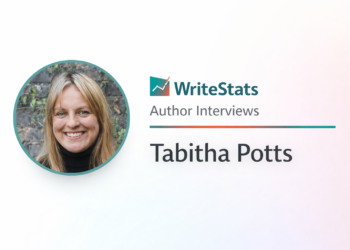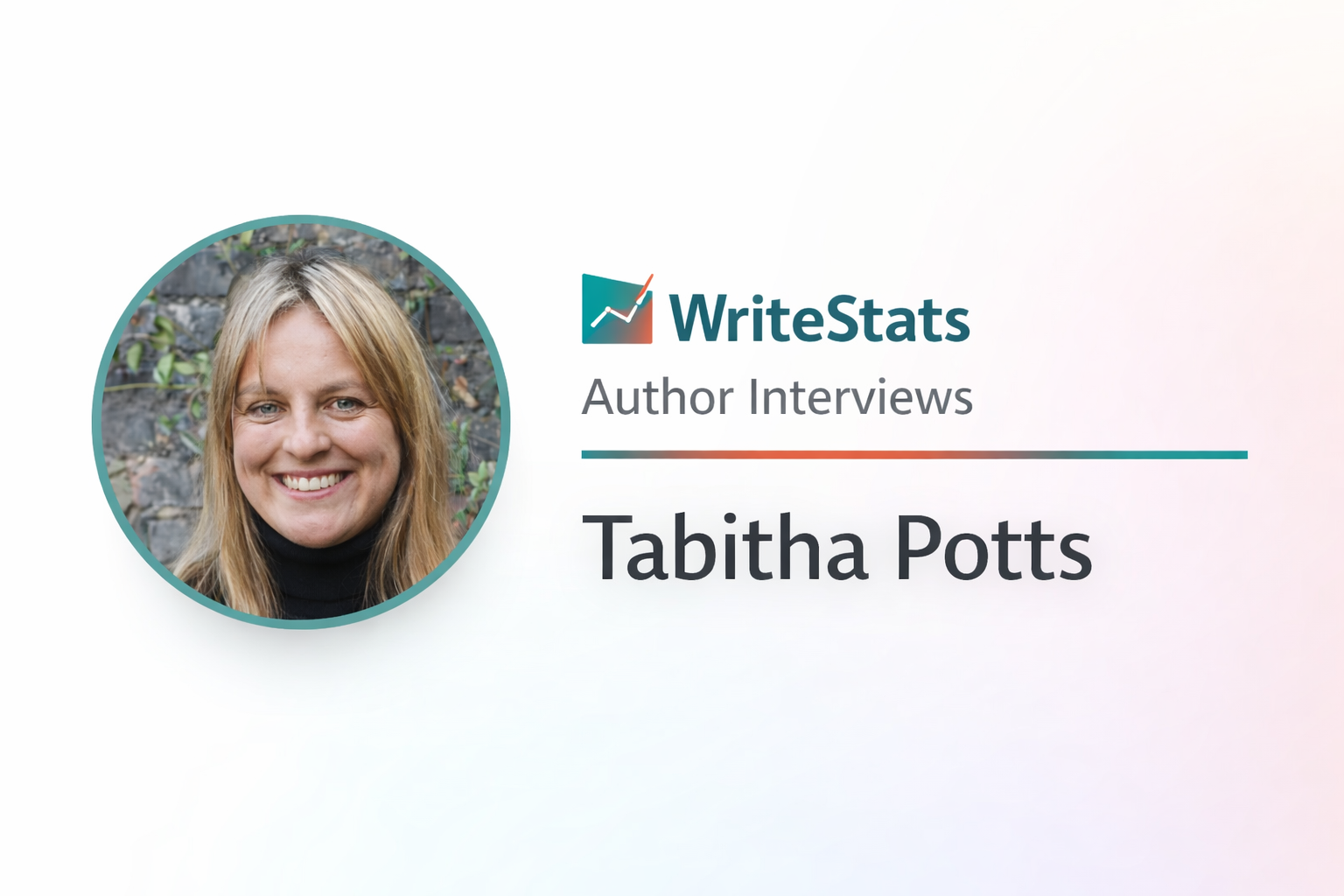
When you speak to Tabitha Potts, one thing becomes immediately clear: she doesn’t just write dark fiction; she lives and breathes storytelling in all its forms.
A UK horror author, podcaster, and prize-longlisted novelist, Tabitha Potts stands at a compelling intersection of traditional publishing, self-publishing short stories, screenwriting, and literary community building. Her debut novel, The House of Dust and Shadows, is set for release in June 2026 with Rowan Prose Publishing, while her earlier collection, A Book of Short Stories, was self-published in 2024 via Wish Hounds Press .
In this WriteStats interview, Tabitha Potts discusses her influences, her publishing decisions, her ADHD diagnosis, her stance on AI in publishing, and the kind of literary legacy she hopes to leave behind.
And what emerges is a portrait of a writer driven by passion and, in her own words, “sheer bloody-mindedness.”
From Childhood Radio Shows to the Story Radio Podcast
Tabitha Potts’ journey as a writer began early, and organically.
“As a child I loved reading and writing and I think it really began then. My parents were both great readers and gave me lots of books. We also didn’t have a television.”
In fact, long before launching the Story Radio Podcast, she was recording homemade radio programmes on a tape recorder.
“I still have books and magazines I wrote as a child and I used to record ‘radio’ programmes on a tape recorder as well — interesting because I now run a podcast!”
There’s something powerful about that throughline: early creative play evolving into a professional platform that supports other writers.
And notably, she reads around 150 books per year, a figure that aligns strongly with data showing high-volume readers are significantly more likely to pursue writing professionally. Reading isn’t just inspiration for Tabitha Potts; it’s infrastructure.
Literary Influences: Gothic, Folk Horror, and Dark Fiction
If you’re familiar with The House of Dust and Shadows, her aesthetic makes sense.
“I have so many influences but I think the short story writer who has influenced my writing the most is Angela Carter — specifically The Bloody Chamber — and in terms of my novel writing the Brontë sisters.”
She continues:
“I love dark fiction, the Gothic, the Romantic, folk horror and the supernatural.”
Her upcoming novel was discovered during a Twitter pitch event called PitDark and later compared to Shirley Jackson by her publisher, a comparison that signaled alignment with her creative intent .
That validation mattered.
“She was kind enough to compare my work to Shirley Jackson so I knew I’d found someone who understood what I was trying to achieve.”
Understanding between writer and publisher isn’t just emotional; it’s strategic. And for authors navigating publishing options, this echoes many of the considerations explored in our analysis of hybrid versus independent routes:
👉 Hybrid Publishing vs Self Publishing: Which Path Is Right for You?
Tabitha Potts on Self-Publishing vs Traditional Publishing
Before signing with Rowan Prose Publishing, Tabitha Potts self-published her short story collection.
“I chose Amazon for my short story collection because I had experimented with Kindle Create and felt relatively confident with it. I also set up on Ingram so libraries and bookshops could stock my book. I also have my book available on Draft2Digital so US libraries can stock it.”
This is a sophisticated distribution strategy, combining Amazon visibility with expanded library reach. It reflects an author who understands publishing infrastructure, not just craft.
Interestingly, her cover illustrator was discovered in an unexpected place:
“I found the work of an incredible illustrator for sale in my local cemetery park on a tea towel! I got in touch with her and she illustrated the cover.”
There’s something poetic about finding gothic art in a cemetery park and building a publishing partnership from it.
Now, however, she works with Vellum for formatting and has transitioned to traditional publishing for her novel. And when asked if she recommends her publisher?
“Yes.”
Clear. Direct. Confident.
Rejection, Stubbornness, and the Writer’s Mindset
Like most professional writers, Tabitha Potts has faced rejection.
But rather than deterring her, it fuels her.
“I’ve faced a great deal of rejection like most writers… but also I’m afraid some of it is sheer bloody-mindedness. I’m extremely stubborn and if someone says ‘No’ I think to myself ‘I’ll show you.’”
There’s a measurable pattern here. Data across publishing surveys consistently shows persistence, not talent alone, predicts long-term author success.
Tabitha Potts embodies that pattern.
ADHD and Writing: Hyperfocus and Burnout
In a candid part of our interview, Tabitha Potts shared:
“I was recently diagnosed with ADHD and it explains a huge amount. I am able to hyperfocus and achieve a huge amount when I am engaged but I can burn out if I am not careful.”
She adds:
“I don’t like repetitive tasks and editing is my least favourite part of writing.”
This insight is crucial. Many writers report similar cognitive rhythms: intense creative output followed by depletion. Recognizing this pattern allows for healthier creative planning, especially during the editing phase, which research consistently identifies as the most cognitively taxing stage of book production.
Tabitha Potts on AI in Publishing
Her position on AI in publishing is nuanced, but firm.
“I am against using AI tools.”
And yet:
“I think AI should be kept to spell checking and editing… I’ve seen a lot of AI copy on websites and it has irritating tropes and is quite easy to recognise.”
Interestingly, she adds:
“I’m very techy and have built custom GPTs and am working on an AI coded app myself, I just don’t think they write particularly well.”
This duality reflects a growing trend among authors who support AI as a utility tool but reject it as a creative substitute.
Crafting Atmosphere and Haunting the Reader
When asked about legacy, her answer was striking:
“I would love my stories to leave questions and images behind in the reader’s mind. I want to haunt them…”
That desire to “haunt” is deeply tied to atmosphere, one of the most critical components of gothic and horror fiction.
If you’re exploring how to build that same lingering effect in your own work, we’ve broken down the mechanics in detail here:
👉How to Create Atmosphere in Writing: The Secret to Unforgettable Stories
Tabitha Potts isn’t just aiming to entertain. She’s aiming to imprint.
What’s Next for Tabitha Potts?
Beyond The House of Dust and Shadows, she’s currently working on a new novel:
“It was long-listed for the Penguin Michael Joseph Undiscovered Writers Prize… it involves Celtic folklore and murder and I’m very excited about it.”
Dark folklore. Murder. Literary recognition.
All signs point to an author refining her voice and expanding her reach.
Final Thoughts: The Endurance of Tabitha Potts
What defines Tabitha isn’t simply that she writes gothic fiction.
It’s that she builds ecosystems around storytelling through self-publishing strategy, traditional partnerships, podcasting, literary prizes, and community engagement.
She reads 150 books a year.
She rejects AI shortcuts.
She persists through rejection.
She wants to haunt her readers.
And ultimately, that combination, discipline plus obsession plus stubbornness, is what turns writers into lasting voices.
If her trajectory tells us anything, it’s this: dark fiction is alive, evolving, and in very determined hands.