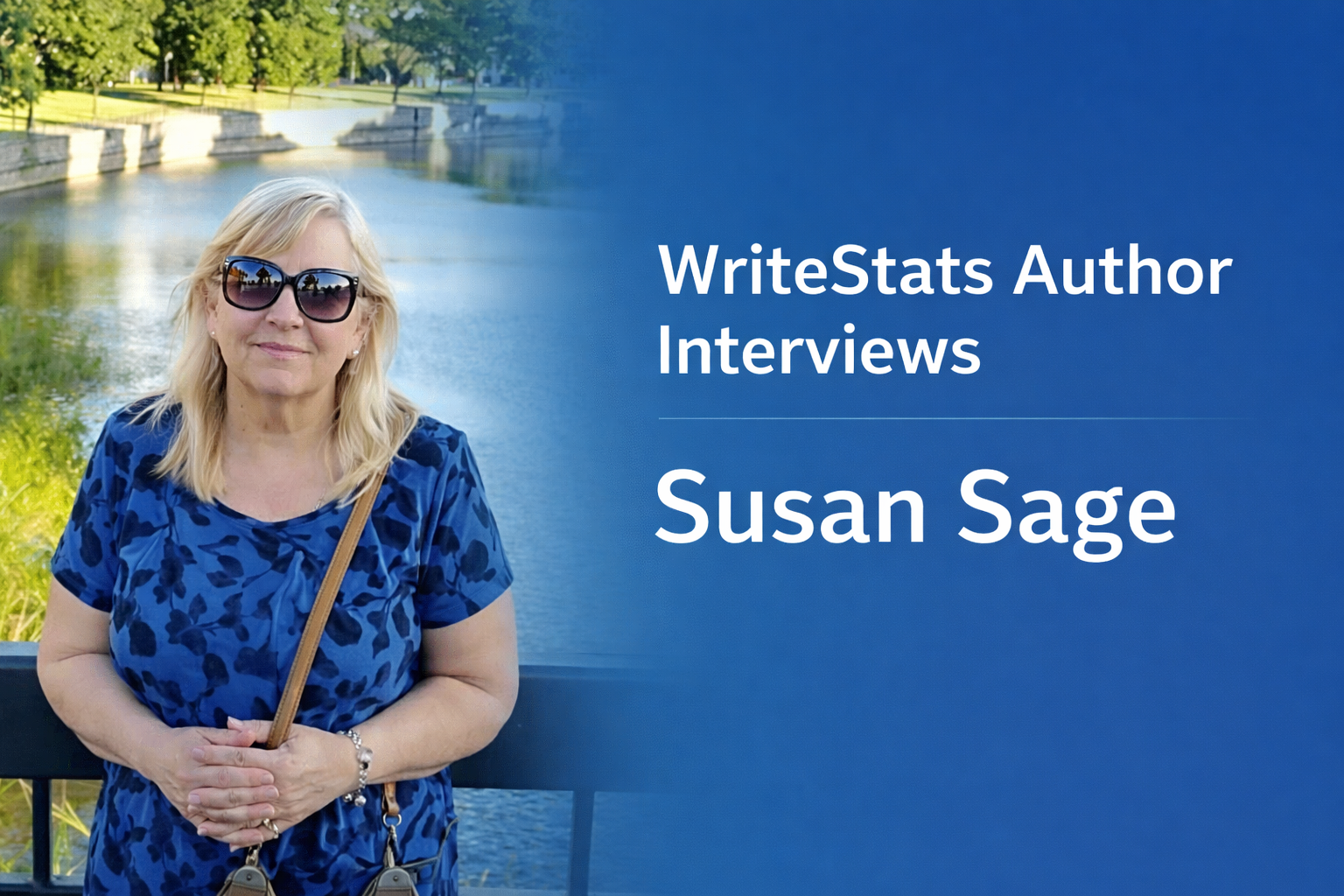
Susan Sage has built a literary career defined by emotional depth, genre fluidity, and an unwavering commitment to storytelling, even when the rewards are modest and the work is demanding. An award-winning, multi-genre author of literary fiction, magical realism, slipstream, women’s fiction, and historical fiction, Susan Sage has published four novels that explore ambition, memory, marriage, collapse, and hope.
Before diving into our interview, it’s worth grounding readers in Susan Sage’s body of work. Her novels include Insominy, A Mentor and Her Muse, Dancing in the Ring, and Silver Lady: Travels Along the River Road. Collectively, these books span speculative worlds, psychologically complex relationships, richly researched historical settings, and near-future journeys shaped by quiet magic and social fracture. Again and again, Susan Sage returns to emotionally honest characters navigating liminal moments: personal, cultural, and moral.
Below, Susan Sage shares her journey in her own words.
A Writer Formed Early by Story
For Susan Sage, writing didn’t begin as a career plan; it began as an instinct.
“My journey as a writer began when I was about 8 years-old. I loved reading and had, what seemed at the time, a great idea for a story.”
However, that early ambition came with frustration.
“Unfortunately, I didn’t have a rich enough vocabulary and felt frustrated not to be able to write it. I drew the characters and came up with plot points.”
This origin story matters. Long before publication, Susan Sage was already thinking structurally about character, plot, and image. Even then, storytelling wasn’t optional; it was inevitable.
Influences, Motivation, and the Central Role of Reading
When asked what has influenced her writing the most, Susan Sage doesn’t hesitate:
“Reading books—especially novels!”
That answer aligns closely with what WriteStats data consistently shows: prolific readers tend to become more resilient writers. Reading isn’t just inspiration; it’s apprenticeship.
And when writing gets difficult—as it inevitably does—she relies on a deeply internal motivation:
“Simply the overwhelming feeling of not wanting to do anything else (except read books).”
In other words, writing persists not because it’s easy or lucrative, but because it’s the only work that feels true.
The Writing Process: Simple Tools, Consistent Habits
Despite writing across genres, Sage’s process is refreshingly straightforward:
“A pen and notebook, as well as my laptop for internet research and typing book drafts.”
She also reports reading around 24 books per year, reinforcing the strong feedback loop between reading and writing that our broader WriteStats research continues to confirm.
Susan Sage on Traditional Publishing Realities
As a traditionally published author, Susan Sage reached her first publishing offer after sending 10 queries over 12 months, a timeline that closely matches industry averages for small-press traditional publishing.
Her experience with her publisher reflects a reality many authors recognize:
“My publishing company is small. While it’s considered to be traditional, representation by an agent is unnecessary.”
There are benefits, she notes:
“The publisher himself is very personable and helpful.”
However, there are also limits:
“Unfortunately, while there are some marketing discounts, most promotional efforts are left up to the author.”
This echoes a key finding across WriteStats interviews: traditional publication does not eliminate the need for author-led marketing, it simply reshapes it.
Still, Sage is clear in her assessment:
“Do you recommend your publisher to other writers? Yes.”
Full-Time Author, Modest Royalties, Real Persistence
Susan Sage considers herself a full-time author, even though writing contributes very little to her income:
“Very little. My royalties are small.”
This honesty matters. It reframes success not as financial dominance, but as sustained creative output over decades.
Her biggest challenge?
“My biggest challenge is effectively promoting my books.”
Although she notes that
“I have a fairly large following on social media platforms and this helps, at least somewhat,”
the challenge remains ongoing, another data point aligning with industry-wide trends.
Susan Sage on AI, Craft, and Creative Boundaries
When it comes to AI, Susan Sage draws a clear line between assistance and authorship:
“I believe AI used in editing and promotional work is fine. I am opposed to it helping me with the creative end of the writing process.”
This nuanced stance reflects a growing consensus among experienced authors: AI can support efficiency, but meaning and voice remain human responsibilities.
Legacy, Meaning, and What Comes Next
Asked about the legacy she hopes to leave, Susan Sage answers simply and powerfully:
“I hope my novels are enjoyed by readers and that impressions I make are lasting ones.”
She’s currently working on a sequel to Silver Lady: Travels Along the River Road, expanding its dreamlike, near-future world:
“In the first book, a civil war is about to break out… In the sequel, the war is over and the same woman is ushering a group upstream.”
Importantly,
“Magic plays a significant, but slightly different role than it does in the first book.”
This evolving use of magic mirrors her broader career—familiar themes, re-examined from new emotional angles.

Why Susan Sage’s Journey Matters
The career of Susan Sage reflects what WriteStats data repeatedly confirms: enduring authorship is built on persistence, reading, emotional honesty, and realistic expectations. Her work aligns closely with the rise of bittersweet, emotionally grounded fiction, a trend we’ve analyzed in depth on the WriteStats blog, particularly in our research on emotional realism and honest storytelling.
Ultimately, Susan Sage reminds us that writing isn’t sustained by hype or shortcuts. It’s sustained by love of the form, respect for readers, and the quiet decision to keep going.
And that, according to the data, is what lasts.