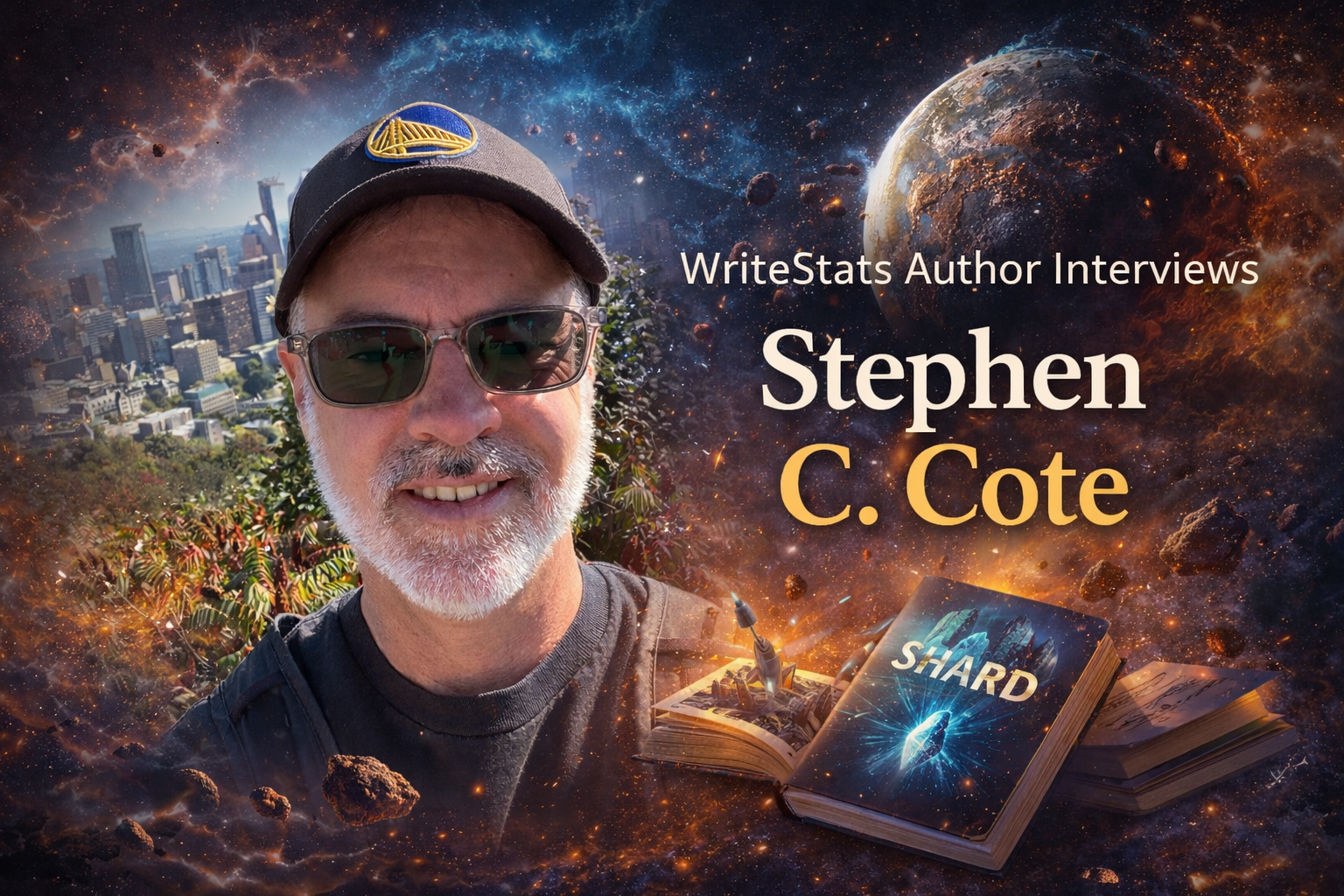
Stephen Cote is a science fiction author whose work sits at the intersection of scholarship, speculation, and curiosity about humanity’s future. A historian by training and a park ranger by profession, Stephen Cote brings an unusually grounded perspective to science fiction. His novels are not only imaginative, but informed by deep engagement with history, science, and systems that shape civilizations.
Stephen Cote is the author of Shard, Through the Rift, and Oil and Nation. Before turning to fiction, he built an academic career publishing peer reviewed research and a historical monograph focused on Bolivia’s oil industry and the political forces surrounding it. Eventually, he made a deliberate pivot away from academia and toward speculative storytelling, a shift that continues to shape his voice and themes today .
In this WriteStats author interview, Stephen Cote reflects on his transition from historian to science fiction author, his creative process, his views on publishing and technology, and the kind of legacy he hopes his stories will leave behind.
Stephen Cote’s Journey from Academia to Science Fiction
Stephen Cote’s writing career began not with fiction, but with scholarship. As he explains,
“I began writing as an academic. I have published multiple articles in peer reviewed publications, and one book, a history of Bolivia that focuses on its oil industry and centers around a war and a revolution” .
This foundation matters. Academic writing trains precision, patience, and long form thinking. However, Stephen Cote also speaks candidly about the emotional reality of leaving that world behind.
“After I left (escaped) academia, I began writing science fiction, journeying away from the past to speculate on the future,” he says .
That shift from documenting what happened to imagining what might happen is central to his work. While history asks why societies behaved as they did, science fiction asks what choices humanity might make next.
The Influences Behind His Fictional Worlds
Stephen Cote’s influences reflect both literary admiration and scientific curiosity. He explains that he is motivated
“by the amazing science fiction stories out there and the actual science being published every day” .
He cites authors such as Neal Stephenson, James Corey, and N K Jemisin, alongside concepts like space elevators, geoengineering, and black hole cosmology. This blend of narrative influence and scientific theory helps explain why Stephen Cote’s stories feel expansive rather than purely speculative.
Instead of treating science as a backdrop, Stephen Cote uses it as a structural element. His worlds feel plausible because they are built on ideas already circulating in research journals and scientific discourse.
This approach aligns closely with our earlier exploration of how atmosphere and credibility shape unforgettable stories, particularly when writers ground imagination in tangible detail. We explored this concept further in our analysis of immersive storytelling here:
How to Create Atmosphere in Writing: The Secret to Unforgettable Stories
What Keeps Stephen Cote Writing When It Gets Hard
Like many authors, Stephen Cote does not romanticize the writing process. When asked what motivates him during difficult stretches, he answers with honesty and humor.
“Coffee,” he says. Then he adds, “Seriously, it’s feedback from the readers that gives me the most motivation to write. Their excitement for the story makes me want to continue to create new worlds” .
This response highlights an important truth about author motivation. While discipline matters, connection sustains momentum. Reader engagement is not just a marketing metric. It is emotional fuel.
For Stephen Cote, knowing that readers care about his characters and worlds creates a feedback loop that encourages continuation rather than abandonment.
Stephen Cote’s Writing Tools and Creative Process
Stephen Cote’s process is notably simple. He relies on “just MSWord and my Mac Book” for most of his writing. However, when he feels blocked, he returns to analog tools. “When I am really stuck, I turn to pen and paper, which is where my best work is done,” he explains .
This insight reinforces a pattern we see across many experienced writers. Creativity often benefits from friction. Writing by hand slows thought just enough to allow ideas to surface more naturally.
He also reads consistently, averaging “30” books per year, which supports continuous exposure to new ideas, styles, and narrative structures .
Publishing Decisions and Platform Experience
When asked how he chose his publishing platform, Stephen Cote’s answer is practical. “Internet research,” he says simply .
He used Draft2Digital for publishing services and describes his experience with his publisher as “smooth sailing.” Importantly, he is willing to recommend his publisher to other writers and has agreed to share his experience publicly in WriteStats’ upcoming publisher directory .
This transparency matters. Many authors struggle to assess publishing services due to limited firsthand accounts. His willingness to share his experience contributes to a healthier information ecosystem for writers navigating similar decisions.
Balancing Writing with Life Beyond Publishing
Stephen Cote does not consider himself a full time author. When asked how much he depends on writing for income, his answer is direct. “Not at all,” he says .
This independence allows creative freedom. However, it also comes with its own challenge. “Time,” he says, when asked about the biggest obstacle he faces as a writer. “I write slowly” .
This admission is especially valuable for emerging writers. Progress is not always about speed. For Stephen Cote, depth and thoughtfulness outweigh production pressure.
On AI and the Future of Publishing
Stephen Cote’s perspective on artificial intelligence is nuanced rather than reactionary. “I am with using AI,” he says, before clarifying,
“I write my own work in my own voice. I am okay with AI for marketing” .
This balanced stance reflects a growing consensus among authors. AI can support discovery, logistics, and visibility without replacing creative authorship.
Stephen Cote’s approach emphasizes intentional boundaries. Technology is a tool, not a substitute for imagination.
Legacy, Impact, and What Comes Next for Stephen Cote
When asked about the legacy he hopes to leave behind, Stephen Cote frames it with humility and optimism.
“Hopefully someone will be inspired to think big and create positive change. Or at least have a good laugh at my stories,” he says .
Looking ahead, he is working on book three of the Shard series. He explains that it
“answers a lot of questions that were left hanging, while opening up new universes. Earth is again in big trouble. And there are more shards” .
This balance of resolution and expansion mirrors the thematic core of his work. Answers matter, but curiosity matters more.
Why Stephen Cote’s Path Resonates with Modern Authors
Stephen Cote’s story resonates because it challenges common assumptions about success. He did not abandon writing when he left academia. He redirected it. He did not rush to monetize creativity. He prioritized meaning.
For authors navigating uncertainty, he offers a powerful reminder. There is more than one valid path. Depth can coexist with imagination. And thoughtful storytelling still matters in an increasingly noisy world.
Stephen Cote’s journey shows that writing careers are not linear. They are adaptive. And sometimes, the most compelling futures are imagined by those who have spent years studying the past.