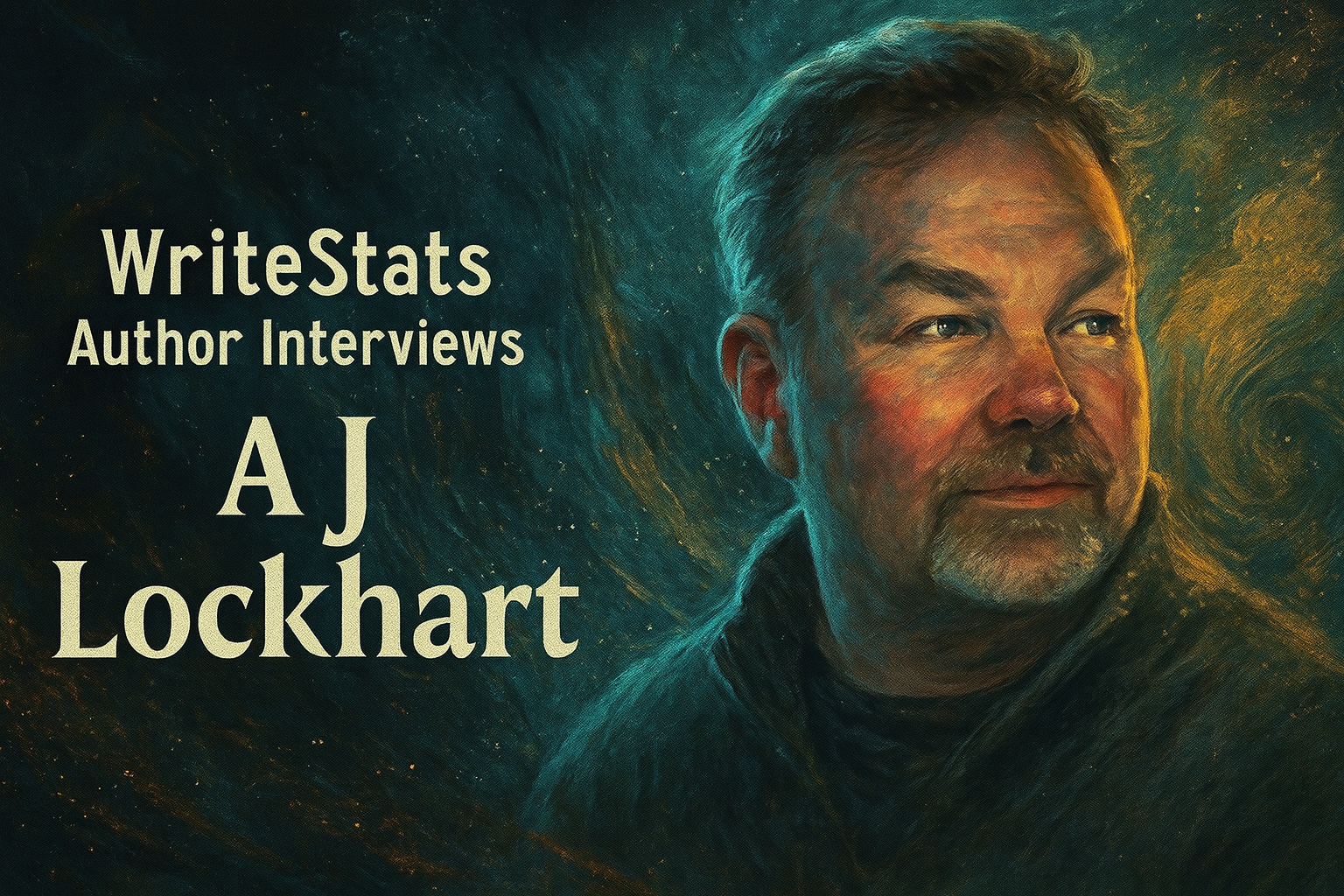
Introducing A J Lockhart: Writer, Worldbuilder, and Creator of The Beyond Use Series
A J Lockhart describes himself simply and humorously on his site as a “writer and cake eater.” But behind that playful introduction is an author who has spent years developing a large speculative universe, refining his voice, and shaping stories designed to challenge readers. His upcoming book, Pandora’s Secret, is positioned as the first installment of The Beyond Use Series, a science fiction concept built around mystery, technology, and emotional consequences.
His website presents the project as “coming soonish,” which reflects both the scale of his worldbuilding and the careful attention he places on quality. From his interview, it is clear that this is not a quick or impulsive project. He notes, “I have been creating story worlds for years,” and shares that his ideas often come fully formed as “pictures inside my head” that he then learns to translate into narrative.
Pandora’s Secret appears to be the anchor point of a larger arc, one that blends science fiction, character-driven storytelling, and a central question about what humans do with knowledge they are not prepared to handle. As he explained, “I always write stories that follow the consequences of actions. Choices matter. Secrets matter. That is where the tension comes from.”
Understanding this mindset gives writers a unique perspective on how to approach their own projects. Worldbuilding is not about scale; it is about intention. A J Lockhart chooses stories that revolve around moral pressure and emotional fallout, which is precisely the kind of foundation that keeps readers invested long after a book ends.
Why A J Lockhart Writes: Dyslexia, Curiosity, and the Urge to Create New Worlds
Every author has an origin point. For A J Lockhart, that point is shaped by both challenge and curiosity. In the interview, he shares openly that he has dyslexia, describing it not as a barrier but as a factor that shaped his relationship with language. Instead of memorising spelling rules or rigid structure, he experiences stories visually and emotionally.
“I see my stories in scenes,” he explains, “sometimes as if I am watching them unfold.”
This mirrors what we explored in our piece on creating atmosphere in writing, where we noted that immersive storytelling comes from writers who “invite readers into a feeling rather than a fact.” A J Lockhart does exactly this by imagining first and writing second.
He also shared that his ideas rarely come from direct experience. Instead, he is inspired by questions.
“I never base characters on myself. I do not want to see me reflected in a story. I want to explore situations I will never face and ask what would someone do with impossible choices.”
This philosophical lens explains why his work leans toward science fiction and speculative ethical dilemmas. He writes to explore what it means to be human under pressure.
Writers reading his interview can take a crucial insight from this. You do not need to start with message or theme. Start with the question that keeps you awake. Then build outward.
The Evolution of His Writing Process
A J Lockhart’s writing process is layered, nonlinear, and deeply intuitive. Many authors fear that they need a single structured approach to write consistently, but his interview reveals that a fluid process can also produce sophisticated results.
He shared that he drafts scenes as they appear to him, often out of chronological order.
“Sometimes I write the climax before the opening,” he told us, “because that is the moment I understand most clearly.” He later connects these pieces through rewrites and structural passes, shaping the flow into a cohesive arc.
This process makes sense for writers who think cinematically. His earlier experience with screenwriting reinforces this effect.
He explains, “Screenwriting taught me to strip scenes to their purpose. If a scene does not move the story, I remove it.”
This discipline becomes especially useful in long-form fiction because it reduces the risk of sagging middles and unnecessary exposition.
Interestingly, he also mentioned that he writes dialogue first.
“Dialogue reveals who characters are. Once I hear their voice, I know how the story should sound.”
This approach aligns with character-driven writers who rely on emotional movement rather than plot scaffolding.
For authors trying to refine their own process, consider a hybrid approach. Write your clearest scenes first, even if they are not the beginning. Then give yourself permission to assemble them later. Creativity thrives when it is not forced into linear shapes too soon.
How A J Lockhart Builds Worlds: Structure, Consequence, and Emotional Atmosphere
One of the most striking elements of the interview is the emphasis A J Lockhart places on atmosphere. Although Pandora’s Secret is a science fiction story, he is not primarily concerned with scientific detail. Instead, he focuses on emotional texture.
He says, “Atmosphere is what makes a world feel real. I want readers to feel the weight of the choices my characters make, not just the setting around them.”
A J Lockhart builds atmosphere through sensory detail, internal conflict, and the moral stakes of his world. He does not treat technology as spectacle. Instead, he treats it as the environment that influences character decision-making.
He also explained that he outlines only loosely. Worldbuilding for him is not a spreadsheet; it is a consequence map.
“If a character does something early, I have to follow the fallout. That is how the world expands.”
Writers can learn a powerful lesson here. Instead of overwhelming yourself with encyclopedic world lore, focus on cause and effect. Worlds feel alive when actions shape reality.
What Inspires A J Lockhart: Influences, Interests, and Genre Curiosity
His influences are eclectic. He referenced film, television, classic speculative fiction, and real-world ethics as sources of inspiration. But he also said something revealing:
“I do not want to copy anything. I want to respond to what I wish had gone differently in the stories I love.”
Many great writers emerge from this creative tension. They do not imitate. They revise the emotional experience they had as a reader or viewer.
This is also why he avoids limiting himself to one genre. He explained that Pandora’s Secret involves mystery, science, emotional conflict, and slow-building tension. That combination reflects modern reader expectations. As we noted in Author Analytics 101, reader behaviour data shows that genre boundaries are blurring. Readers gravitate toward hybrid narratives with layered experiences, and A J Lockhart’s work fits that evolving trend.
How He Approaches Character Creation
A J Lockhart’s characters begin as reactions rather than archetypes. He said:
“I never write characters who reflect me. Instead, I build them from the situation. What type of person would this moment break and what type of person would it transform.”
This approach focuses on emotional trajectory rather than traits. Characters are defined by what changes them. That method naturally creates depth and realism.
He also mentioned that dialogue is his entry point to character. When he hears a character speak, he knows where to take them. This auditory approach is common among dyslexic storytellers who rely on rhythm and emotional tone rather than linguistic technicalities.
Writers struggling with character design may benefit from this model. Start with a moment you want the character to face. Then shape the character around the emotional cost of that moment.
Challenges He Has Faced as an Author
The interview covers real frustrations. A J Lockhart explained the difficulty of balancing creativity with self-doubt.
“Some days I look at what I wrote and think it is great. Other days I think it is nonsense.”
Every writer knows this feeling.
He also shared that dyslexia slows his editing process.
“The words move sometimes, so I need more passes. But it forces me to be deliberate.”
This honesty is invaluable for writers who feel pressured to write quickly. Writing slowly does not diminish quality. It often enhances it.
He also talked about the emotional weight of creating something personal.
“I have carried these stories for years. Sharing them is terrifying and exciting.”
Writers reading this should note that fear is part of the creative process. What matters is not eliminating fear but writing through it.
Pandora’s Secret: Themes, Tone, and Why This Story Matters
Based on the interview, Pandora’s Secret revolves around a dangerous discovery, a morally complex truth, and the tension between responsibility and curiosity. He explains:
“I wanted to write a story where knowledge becomes a temptation and a burden.”
This theme places the novel in the tradition of psychological science fiction, where the focus is not on spectacle but on emotional impact. It also hints at an atmosphere of tension and secrecy, which creates the conditions for powerful narrative momentum.
He also revealed that the story will have layered reveals.
“I let the reader discover the truth as the characters do. I do not explain everything up front.”
This aligns with the modern preference for immersive storytelling, where readers uncover the world through experience rather than exposition.
What Writers Can Learn from A J Lockhart
Through this interview, A J Lockhart offers several practical lessons for writers at any stage.
1. Let your story evolve rather than force it into a rigid outline
He writes by following emotion and consequence. That method keeps his stories dynamic and character grounded.
2. Use atmosphere intentionally
He views atmosphere as an emotional tool, not a decorative layer. This mirrors industry data showing that readers connect deeply with tone and mood.
3. Build worlds through consequence
Instead of designing lore first, he builds worlds through cause and effect. This keeps worldbuilding relevant to the story.
4. Dialogue can anchor character identity
His process shows that character voice reveals emotional truth more effectively than checklists of traits.
5. Writing challenges do not limit creativity
His dyslexia has shaped his process but not restricted it. Instead, it has strengthened his focus on clarity and intention.
The Future of A J Lockhart and The Beyond Use Series
A J Lockhart stands at the beginning of a promising journey. Pandora’s Secret has the potential to introduce readers to a world shaped by tension, consequence, and emotional depth. His creative process is a valuable model for writers who want to merge imagination with introspection.
He writes because he is curious about what people do when pushed to their limits. He builds worlds that ask difficult questions. He embraces atmosphere, tension, and the emotional weight of storytelling. With that foundation, his future work has a strong chance of resonating with readers who want stories that stay with them.
As he continues developing his series, we look forward to seeing how his world expands and how his characters evolve under the pressures he designs for them. Writers who follow his journey can learn much from his blend of intuitive creativity and thoughtful craft.
Pandora’s Secret may still be coming soon, but the voice behind it is already clear.