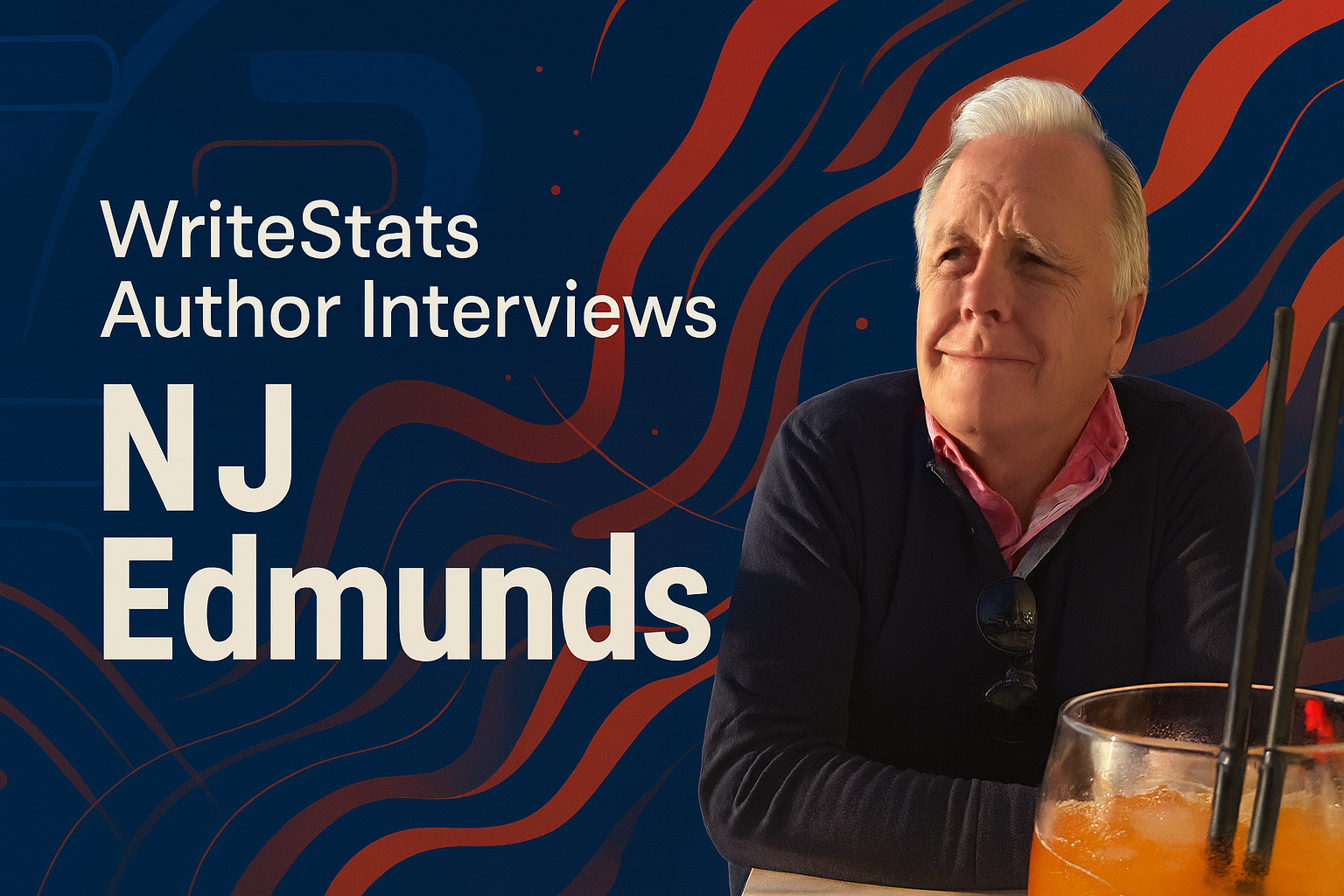
Who Is N J Edmunds?
Every so often, WriteStats encounters an author whose creative journey is so layered and deeply grounded in lived experience that the story behind the books becomes as gripping as the books themselves. N J Edmunds is one of those writers.
A retired doctor living in Scotland, Edmunds has transformed decades of medical work, note-taking, and real-world human observation into a growing body of psychological and crime fiction. His published works include:
- Miles Away: Memories Can Kill (Flint & Masson #1, revised edition 2025)
- Flowers for the Slaughterman (Flint & Masson #2, 2025)
- Ragged Island (2025)
- Up the Dollar Road and Other Short Stories
Together, they showcase an author who blends atmospheric Scottish settings with the precision of a lifelong medical professional, an uncommon pairing that gives his stories striking clarity and emotional realism.
And yet, his writing career began not at a desk in his twenties, but after retirement. As he tells us, “I retired after decades working as a doctor in Scotland. My head was full of stories.” From there, a short piece “grew into my first full-length book,” leading to Miles Away in 2022.
In this in-depth interview, Edmunds shares the habits, motivations, and challenges that shape his creative life, offering lessons particularly resonant for indie authors and writers pursuing second careers.
A Career of Observation: How Writing Found Him Later in Life
While many authors describe a lifelong desire to write, Edmunds speaks of a quieter shift, one that emerged organically once the pressures of medical life eased. After years spent composing detailed notes, reports, and legal summaries, he found that his professional voice had already prepared him for fiction.
As he explains:
“My own varied reading, and my work life spent writing clear, legible notes, reports, and letters… [these] influenced my writing the most.”
This transition from factual precision to fictional storytelling highlights a pattern we’ve documented before, particularly in our blog “93% of Indie Authors Are Happy They Self-Published,” where many late-career writers cite accumulated life experience as their greatest creative asset.
For Edmunds, that experience is what fuels the ideas that keep him returning to the page:
“The ideas that come to me at night. Every morning I want to write something.”
The Tools and Tactics Behind His Writing Process
Writers often love to debate tools, such as Scrivener vs. Word, notebooks vs. phones, and whether to use AI or not. Edmunds has formed a process as structured as one would expect from a former GP:
- Scrivener for initial drafts
- LibreOffice for later stages
- Notes app for quick ideas
- Pencil and paper rarely
He puts it simply:
“I use a Mac… start on Scrivener… move to LibreOffice… make short notes in the Notes app.”
Interestingly, his reflections echo findings in our study, “When Do Writers Write Best?” where authors with long professional careers often prefer structured digital systems over more improvisational methods.
Choosing Independence: Why N J Edmunds Left Traditional Publishing
One of the most compelling parts of Edmunds’ story is his transition from traditional to independent publishing, a shift increasingly common among authors seeking agency, speed, and creative freedom.
His first novel was traditionally published after an independent press approached him. Initially positive, the experience ultimately stalled his momentum:
“He took two years to decide whether or not to move forward with the next two manuscripts… still hadn’t read either of them.”
That delay pushed Edmunds toward self-publishing and toward the sense of control celebrated by thousands of authors we surveyed in our 93% Self-Publishing Satisfaction Report.
Now, he uses:
- Amazon KDP (“it seems unwise not to”)
- IngramSpark for broad distribution
- Draft2Digital for effortless ebook formatting
Edmunds summarizes the appeal perfectly:
“I like the independence and complete control it allows me.”
The path wasn’t without experimentation. He tried Fiverr for a cover, wasn’t satisfied on the second round, and eventually designed the Ragged Island cover himself. Meanwhile, the Flowers for the Slaughterman cover originated from an artist’s painting, another example of how indie authors often blend resourcefulness with collaboration.
The Realities of Writing Time, Motivation, and Balance
Unlike many emerging writers, Edmunds does not depend on his writing for income:
“I am a fortunate hobbyist with no need to rely on income from writing. I know I will never make money, but enjoy the process.”
This honesty is refreshing and statistically typical. Many authors in our dataset report writing as an “income-neutral passion,” particularly in later life.
That said, he faces the universal challenge:
“Not having time enough to spend on writing without impacting on my home life.”
Writers of every age echo this tension, a finding strongly reinforced by our analysis of creative peak hours. Creative energy is real, but so is the pressure of daily life.
A Firm Stance on AI: Why He Rejects Artificial Assistance
In an era where AI is slowly integrating into every stage of the publishing pipeline, Edmunds’ position is unusually clear and unequivocal:
“I am against using AI tools.”
“I write my own words… I don’t see the point of putting my name to something a machine has created.”
This perspective is increasingly common among authors who see writing not merely as production, but as personal expression. It also aligns with a sentiment we’ve documented among traditionally trained professionals entering creative fields later in life, for many, authenticity outweighs efficiency.
Looking Ahead: What’s Next for N J Edmunds
Even with multiple books already published, Edmunds sees himself at the beginning of his fiction career. Book Three in the Flint & Masson series is in its early stages:
“So far little more than some notes and a vague outline.”
For now, his focus is on promoting Flowers for the Slaughterman, but readers can also expect more nonfiction-style writing through his popular column in a Scottish magazine:
“The editor entitles ‘The Dr Edmunds Anecdotes.’ I have several prepared for upcoming issues.”
Given his background, these anecdotal pieces may become an increasingly significant part of his author brand.
Why N J Edmunds’ Story Matters
At WriteStats, we analyze thousands of authors each year, their processes, habits, outcomes, frustrations, and breakthroughs. N J Edmunds stands out because his journey demonstrates:
- The creative potential of second careers
- The appeal and empowerment of indie publishing
- the discipline of a lifelong professional
- the resilience required to keep writing through doubt, delay, and distraction
- The ongoing evolution of an author unburdened by commercial pressure
Most importantly, his story reveals the deeply human origin of crime fiction, which resonates with readers: a lifetime spent witnessing people at their most vulnerable and authentic.
His hope for his legacy is simple, and it’s one shared by countless storytellers:
“I hope my writing will be recognised as worthwhile.”
Based on everything he’s building, the series, the short stories, the reflections, the discipline, it already is.