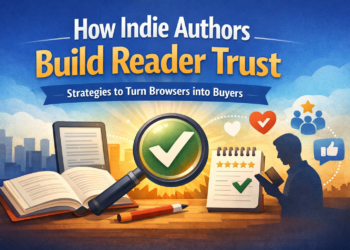
Building Reader Trust as an indie author is what makes the difference between a book that gets browsed and a book that gets bought. Visibility can bring people to your page, but credibility is what turns curiosity into commitment. When a reader meets an unfamiliar author, they do not just evaluate the story. They evaluate the risk.
They wonder if the writing will be good, if the book will match the promise, and if buying it will feel like a mistake compared to safer choices. That uncertainty is why many indie books struggle with conversion even when the cover is getting clicks and the blurb is getting reads.
The good news is simple. How indie authors build reader trust is not mysterious. It can be engineered with specific signals, systems, and reader first choices. When those signals are present, hesitation drops. When hesitation drops, sales rise.
This guide is a practical playbook. It uses consumer psychology, publishing data, and platform behavior to show how indie authors build reader trust step by step. You will get actionable tips, examples, and a clear audit path so you can implement changes that produce measurable results.
The Trust Gap: Why Indie Books Feel Riskier to New Readers
Traditional publishing benefits from inherited credibility. For decades, readers have been conditioned to treat major imprints as quality filters. When a book is traditionally published, readers assume professional editing, professional design, and at least some level of selection.
Lindsay Buroker explains that publisher branding acts as a shortcut. Readers do not have time to evaluate everything. They use signals that reduce decision fatigue and protect them from disappointment.
Indie authors enter the market without that institutional endorsement. Self publishing has also increased variability. Readers have seen excellent indie books, but they have also seen books with weak editing, confusing blurbs, or misleading genre signals. Good e-Reader points out that many readers approach indie ebooks with more caution because the market contains a wide range of quality and presentation.
This is not a moral judgment. It is risk management.
That is why learning how indie authors build reader trust starts with acknowledging perceived risk rather than arguing with it.
How Indie Authors Build Reader Trust by Reducing Perceived Risk
Perceived risk theory is a core concept in consumer behavior. Research summarized by 20i explains that when perceived risk rises, purchase likelihood falls. Consumers delay decisions, seek more information, and rely more heavily on familiar brands.
Readers face four major risk types when deciding whether to buy an indie book.
Performance risk is fear that the story will not deliver. Financial risk is concern that money is better spent elsewhere. Time risk is fear of wasting hours on a disappointing read. Social risk is hesitation about recommending the book or being associated with poor quality.
A study from the University of Economics in Katowice supports this pattern. When perceived risk increases, consumers rely on social proof and brand familiarity. In publishing terms, this means readers default to authors they already know unless indie authors lower uncertainty.
So the strategy is not to shout louder. The strategy is to make the decision feel safer.
In other words, how indie authors build reader trust is the work of lowering risk at every touchpoint.
A Quick Diagnostic: Is Your Book Page High Risk Right Now?
Before we move into tactics, do a fast check. Open your book page and answer these questions honestly.
- Does the cover instantly communicate genre and tone at thumbnail size?
- Does the first paragraph of the blurb make the reading experience feel specific and familiar?
- Are the tropes and reader promises clear without being spoiler heavy?
- Is there proof that other readers enjoyed it?
- Can a new reader sample the story quickly without wading through pages of front matter?
- Is there an easy next step if they are not ready to buy today?
If you answered no to more than two, the book is being positioned as higher risk than it needs to be. The rest of this guide fixes that.
Also, if you want the deeper context behind why readers sometimes do take chances on unknown authors, our WriteStats breakdown is here:
Why Readers Take Chances on Unknown Authors And How to Position Your Books for Discovery
Tactic One: Building Reader Trust Through Strong Book Samples
A sample is proof. It reduces performance risk more effectively than any promise you can write.
When readers can experience your voice and pacing directly, uncertainty shrinks. They stop guessing and start feeling. This is why sampling is one of the most powerful conversion drivers in book retail.
What Amazon Actually Shows and What You Can Control
There is a common myth that authors can request a larger Look Inside percentage. The current Kindle Direct Publishing documentation says otherwise. KDP states that the reading sample is based on a set percentage by format, including ten percent for most ebooks and twenty percent for paperback and hardcover. KDP also states that reading sample percentages cannot be adjusted.
So, how indie authors build reader trust with samples is not about changing the percentage. It is about making the sample count.
Make the Sample Start Where the Story Starts
If your preview begins with three pages of copyright, a long dedication, and a table of contents, you are spending your most valuable trust window on low impact content.
Action steps:
- Keep front matter lean:
Move acknowledgments and other extras to the back. - Put the hook early:
Ensure the opening scene arrives as fast as possible. - Remove friction:
Avoid long opening exposition if your genre expects momentum.
Practical example:
If you write romance and the first ten pages are backstory, your sample will not deliver the emotional promise quickly. Instead, open with a moment that signals the relationship dynamic or the problem that forces proximity.
Front Load Confidence, Not Hype
A sample also works as a credibility container. You can place a small amount of social proof inside the early pages so readers see validation before they commit time.
However, keep it tight. One page of endorsements is enough. Too much feels defensive.
A useful benchmark comes from consumer review research. BrightLocal reports that in 2025, 42% of consumers trust online reviews as much as personal recommendations. That is lower than earlier years, which means readers are more skeptical, not less. They are reading reviews, but they are weighing them carefully.
So, your goal is not to overwhelm readers with praise. Your goal is to show signals of legitimacy and then let the writing do the persuasion.
Use the Sample to Capture Readers Who Are Not Ready Yet
Even if a reader is not ready to buy today, they may be ready to take a smaller step. That step is your reader magnet.
Place a clear, specific call to action near the beginning and again near the end of the book.
Action steps:
- Offer a reader magnet that matches the promise:
A prequel novella, a bonus epilogue, a side story, or an exclusive chapter. - Make the benefit concrete:
For example, Get the complete prequel story that introduces the world and the main couple. - Make the delivery easy:
Use a service like BookFunnel so readers are not troubleshooting files.
This strategy connects directly to our WriteStats analysis of samples vs reviews and what actually moves the needle for sales:
How to Sell More Books Without Spending More: Reviews vs Samples Explained
Tactic Two: Building Reader Trust With Clear Positioning and Comparables
Readers trust what feels familiar. Comparable titles make your book feel easier to choose.
A strong comparable title does three jobs at once.
- It clarifies genre and tone.
- It reduces performance uncertainty by setting expectations.
- It borrows credibility from an established market.
How to Choose Comparables That Actually Work
A good comparable is not simply a bestseller you admire. It is a book your target reader already bought and loved for similar reasons.
Action steps:
- Choose two comparables, not ten:
One for tone, one for premise. - Match readership more than plot:
If your book has a similar emotional experience, the comp works. - Avoid exaggeration:
Your book can be perfect for fans of an author without claiming it is the next version of that author.
Practical example:
If your fantasy has academy politics, friendships under pressure, and mystery elements, you might position it as for readers who love dark academia fantasy with found family dynamics.
Where to Use Comparables for Maximum Conversion
- The first line of your blurb:
Lead with familiarity. - Your author website:
Create a simple section called If you liked these books, start here. - Your keywords and metadata:
Reedsy explains that Amazon keyword slots can help with discovery when you use relevant phrases and reader language. - Your ads:
Comparable targeting reduces wasted spend because it filters for readers with proven taste.
Tactic Three: Building Reader Trust by Setting Accurate Reader Expectations
Tropes are not a gimmick. They are expectation management.
When readers know what emotional journey they are buying, disappointment risk goes down.
Kristina Elyse Butke explains how trope language has become a mainstream discovery tool, influenced by fanfiction tagging culture and social reading communities. Readers use tropes like a search filter for feelings.
How to Present Tropes Without Spoiling Your Book
Focus on setup tropes rather than ending tropes.

Action steps:
- Choose three to seven tropes:
Enough to clarify the experience without turning the blurb into a list. - Pair tropes with plain language:
For example, enemies to lovers with forced proximity and a slow burn. - Use content notes where relevant:
This reduces risk for readers who want to avoid certain themes.
Practical example:
If you write romantic suspense, add clarity about intensity. Some readers want gritty. Others want cozy danger. If you signal the tone, reviews improve because expectations are aligned.
This also connects to reader patience. When readers feel misled, they quit faster. Our WriteStats analysis on reader patience explains why mismatched expectations create early abandonment:
How Readers Really Decide: What Authors Get Wrong About Reader Patience
Tactic Four: Building Reader Trust With Professional Covers
Readers judge quickly. They cannot help it.
In user experience research, first impressions are formed extremely fast. A classic study by Lindgaard and colleagues found that visual appeal impressions of web pages can form in as little as fifty milliseconds. That is a blink.
Your book cover functions the same way on a storefront. A reader sees it, assigns a category, and decides whether to click.
This is why how indie authors build reader trust starts with cover professionalism.
What a Professional Cover Communicates
A professional cover signals three things.
- This book belongs in this genre.
- This book is produced at a professional standard.
- This author respects the reader.
Even if readers do not consciously articulate these beliefs, they respond to them.
Academic research supports the importance of covers as signals. A paper on choosing books by their cover suggests that covers operate as an implicit signaling system between publishers and experienced readers. Genre cues influence selection and buying.
Actionable Cover Upgrades That Improve Trust
- Audit your cover at thumbnail size:
Shrink it until it is the size readers see on mobile. - Compare to the top one hundred in your subgenre:
Look for pattern alignment in typography, color palette, and focal imagery. - Invest in genre fluent design:
This is not about making a beautiful cover. It is about making a recognizable cover. - Ensure series consistency:
A reader should know instantly that Book Two belongs with Book One.
Practical example:
If your cozy mystery cover uses a dark thriller font, readers feel genre confusion. Confusion increases risk. Aligning cover cues reduces risk.
Tactic Five: Building Reader Trust Using Social Proof and Reviews
Reviews reduce social and performance risk, but only when they look credible.
Two mistakes cause reviews to backfire:
- Too few reviews with no other trust signals
- Reviews that feel unnatural or overly similar
Reviews matter because readers use them as external validation. However, readers are also increasingly skeptical. BrightLocal data suggests that trust in reviews is lower than it once was. That means readers scan for authenticity.
Practical Ways to Make Reviews Work Harder
- Aim for a small baseline
For many genres, even ten to thirty reviews can reduce anxiety. - Prioritize review quality over quantity
A few specific reviews that mention what readers loved are more convincing than hundreds of vague ones. - Use review snippets as micro social proof
Place two short quotes on your website, in your newsletter welcome sequence, and inside your book front matter.
For broader social proof behavior, Trustpilot reports that in a consumer survey, an average of 66% of customers said the presence of social proof increased their likelihood to purchase.
That insight translates cleanly to books. Your goal is not just reviews on Amazon. Your goal is social proof wherever readers need reassurance.
Tactic Six: Building Reader Trust Before Asking for a Sale
A reader magnet is the highest leverage risk reduction tool because it removes financial risk entirely. It lets readers experience your writing with zero cost.
Indie Author Magazine emphasizes that reader magnets are most effective when they are high quality and aligned with the core series promise.
Why Magnets Convert Better Than You Think
Email is one of the highest ROI channels in marketing. Litmus reports that email ROI is often around thirty six dollars returned for every one dollar spent, with ranges depending on industry and program maturity.
For authors, the ROI is not just money. It is direct access to readers without algorithm dependence.
Written Word Media survey reporting shows a striking pattern. In their 2025 author survey, published authors with an email list earned a median of three hundred dollars per month, while those without an email list earned fifteen dollars per month.
This does not prove causation, but it strongly supports the idea that list building is associated with higher earning behavior and better launch capability.
That is why how indie authors build reader trust is not just about the book page. It is also about building a low risk relationship path.
What Makes a Magnet Work
- It is complete:
Readers finish it and feel satisfied. - It matches your main promise:
Same genre, same tone, same emotional experience. - It is professionally presented:
Editing, formatting, and cover quality should match your paid books. - It leads clearly to the next book:
The magnet should naturally point to Book One or Book Two depending on your strategy.
Practical example:
If you write epic fantasy, a prequel novella that introduces the world and the core conflict is ideal. At the end, direct readers to Book One with a clear link and a one sentence hook.

A Simple Magnet Funnel That Builds Trust
- A landing page with a single promise:
Get the complete prequel novella. - A welcome email that sets expectations:
Tell readers what they will receive and what to read next. - A follow up email sequence that feels human:
Share a behind the scenes note, a character introduction, or a reading order guide. - A gentle invitation to review after they buy:
Do not demand. Invite.
Tactic Seven: Building Reader Trust Outside the Book Page
Readers also evaluate you. Not your personality, but your professionalism.
A clear author presence reduces social risk. It signals that you are real, consistent, and accountable.
What to Fix on Your Author Website
- Make the homepage answer three questions fast:
What do you write, who is it for, and where should a new reader start? - Add a start here section:
List your best entry point and why. - Use simple social proof:
A few review quotes, a newsletter subscriber count if meaningful, or award badges. - Make email signup obvious:
Your magnet is your trust bridge.
This aligns with the broader UX principle described by Nielsen Norman Group. First impressions influence credibility and perceived usability. Readers decide quickly whether something feels trustworthy.
High Risk Vs. Low Risk: Two Reader Journeys
To make this practical, here is what risk looks like in the real world.
High Risk Journey
A reader sees a cover that looks slightly off genre.
They click anyway.
The blurb is vague and full of dramatic language but low on specifics.
The sample starts with long front matter.
There are few reviews and no clear explanation of tone.
The reader leaves.
Low Risk Journey
A reader sees a cover that matches the genre they already buy.
They click.
The first line of the blurb positions the book with clear comparables.
Tropes confirm the emotional experience.
The sample opens with story, not paperwork.
There is a small but believable layer of social proof.
If they are not ready to buy, they can grab a free complete magnet.
The reader either buys now or joins your list.
That is how indie authors build reader trust. It is not one trick. It is a sequence of signals that make the choice feel safe.
A Practical Trust Audit Checklist You Can Use Today
Use this checklist to implement changes in the right order.
Book Page Audit
- Cover matches top sellers in your subgenre.
- Title and subtitle communicate genre and hook.
- Description opens with clarity and familiarity.
- Tropes are visible and accurate.
- Tone and intensity are clear.
- Sample starts with story.
- Magnet invitation exists.
- Reviews are present and authentic.
Brand Audit
- Website answers start here question.
- Newsletter magnet is easy to claim.
- Welcome email is friendly and clear.
- Back matter in every book points to the list.
- Series reading order is obvious.
Messaging Audit
- Your marketing language matches the reading experience.
- Your comps are honest.
- Your trope signals match reader expectations.
- Your cover does not create genre confusion.
FAQ: How Indie Authors Earn Reader Trust When Starting from Zero
1. What if I have no reviews?
Use samples, tropes, and comparables to reduce uncertainty. Then focus on building a small baseline by inviting readers at the end of the book to leave honest feedback. Also leverage your reader magnet to build a small community that can support early review momentum.
2. What if my cover is already pretty?
Pretty is not the goal. Recognizable is the goal. Compare it to the top one hundred books in your subgenre. If it does not look like it belongs, it is increasing risk.
3. What if I hate marketing?
This is not about hype. It is about clarity. How indie authors build reader trust is mostly about removing confusion and friction so the right readers can say yes.
4. Do I need a big email list?
No. You need a useful one. A small list that trusts you can outperform a large list that does not engage. Focus on delivering value and matching reader expectations.
Final Thoughts
Readers are not looking to take chances. They are looking for reassurance.
Every decision a reader makes on your book page is shaped by one question. Does this feel safe? Safe does not mean bland. It means clear, professional, and respectful of their time.
When you understand how indie authors build reader trust, marketing stops feeling like persuasion and starts functioning like alignment. The right readers recognize themselves in your positioning. The wrong readers move on without frustration. Both outcomes protect your long term reputation.
Trust compounds. Each improvement you make lowers friction for the next reader.
That is how indie authors build reader trust and turn casual browsers into confident buyers who come back for the next book.