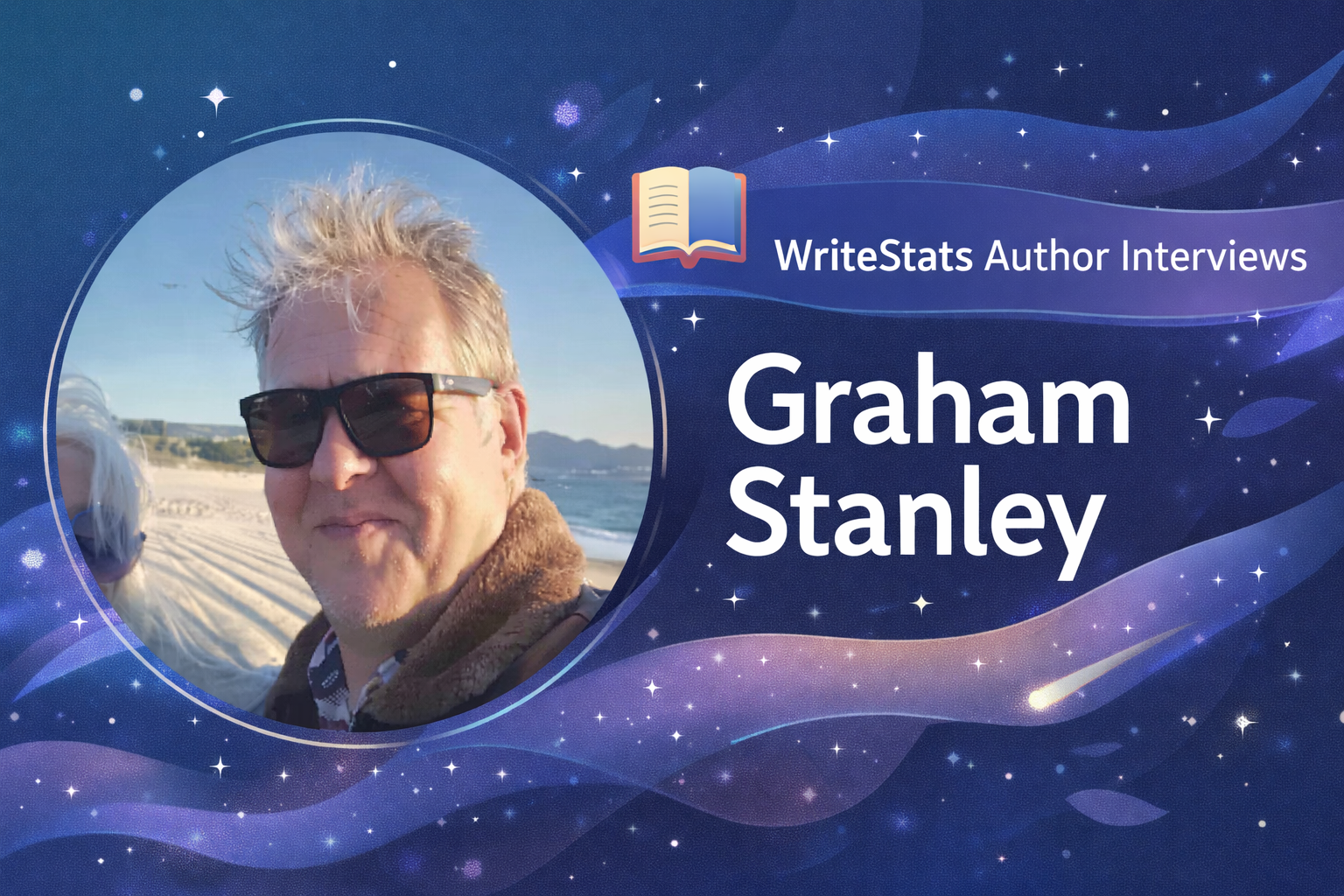
Graham Stanley is an award-winning UK author whose career bridges two worlds: internationally recognized non-fiction in language education and an increasingly ambitious body of speculative fiction. Known online as G. Stanley, he is the author of the Many Worlds Apart trilogy, The Spaceman, What Happened to You, Gordon?, and Connections, a science-fiction series exploring identity, connection, and alternate realities.
Before turning to fiction, Stanley built a respected career writing for educators. His earlier books won major honors from the English Speaking Union and the British Council, achievements that continue to shape his disciplined, reflective approach to storytelling. Today, he writes science fiction, fantasy, and psychological thrillers while openly documenting the realities of self-publishing, reader discovery, and creative persistence.
In this WriteStats Author Interview, Graham Stanley speaks candidly about why he writes, how he structures his creative life, and why enjoyment matters more than outcomes. His answers offer rare insight into the mindset of a writer motivated not by trends or income but by process, curiosity, and craft.
How Graham Stanley’s Writing Journey Began
For Stanley, the desire to write fiction was always there, even when his earliest publications took a different form.
“I’ve always enjoyed writing and always wanted to write fiction, though my first publications were in language education.”
That early phase of his career was anything but minor. In 2011, he co-authored Digital Play, which went on to win a British Council ELTon Award, followed by Language Learning with Technology, which earned the English Speaking Union’s HRH Duke of Edinburgh ELT Book of the Year Award.
However, those successes ultimately pushed him closer to fiction rather than further away from it.
“Subsequently, I became interested in writing and self-publishing my own science-fiction and fantasy novels.”
This transition is a recurring theme in Graham Stanley’s story: experience informing creativity, not replacing it.
Influences That Shape Graham Stanley’s Fiction
When asked about the writers who influenced him most, Stanley names two literary heavyweights but emphasizes breadth over imitation.
“I love writers such as JG Ballard and Kurt Vonnegut, but have tried to read widely across different genres of fiction as I think you can learn from everything you read.”
That philosophy is reflected in the Many Worlds Apart trilogy itself, which blends speculative concepts with psychological depth rather than adhering rigidly to genre conventions.
Why Graham Stanley Keeps Writing, Even When It’s Hard
Consistency plays a central role in Graham Stanley’s creative life, but not in a rigid or punishing way.
“I have a daily routine, which sees me getting up early to write, 7 days a week, although I don’t get stressed if I end up missing some days.”
More importantly, his motivation is rooted in intrinsic satisfaction rather than external validation.
“The important thing for me is to enjoy the process. That’s why I do it. The actual writing is more important than having anything (the finished books) to show for it.”
This mindset closely aligns with research WriteStats has explored on reader immersion and creative momentum including how emotional engagement and intrinsic motivation often lead to stories readers struggle to let go of, a phenomenon we’ve previously examined in our analysis of book hangover psychology on the WriteStats blog.
Tools, Technology, and a Thoughtful Approach to AI
Despite his literary influences, Graham Stanley is anything but resistant to modern tools. His drafting process is intentionally simple:
“I write using Word or Google Docs.”
Yet he also embraces emerging technology where it adds value.
“Recently I have started using Google’s Notebook LM for analysis and critiques.”
His openness extends to generative AI more broadly.
“I think AI tools are here to stay.”
“I now use Google’s Notebook LM for critiques and analysis of my own work and used other Gen AI tools for world building and brainstorming background information for my last book.”
Rather than replacing creativity, he treats AI as a support system, a pattern we increasingly see among experienced authors who value iteration and reflection.
Publishing Choices and the Reality of Self-Publishing
Although Graham Stanley has positive experiences with traditional publishers in non-fiction, fiction led him down a different path.
“My experience with mainstream publishers for my non-fiction books for teachers has been very good, but the process is very slow and lots of it feels out of your control.”
As a result, he made a deliberate decision.
“For those reasons, I knew I wanted to self-publish my fiction.”
Amazon was his starting point, chosen for practicality rather than ideology.
“I only chose Amazon because it was very easy to get started with self-publishing.”
However, he’s already thinking ahead.
“I hope to branch out and publish on different platforms in 2026.”
For editing and production, Graham Stanley emphasizes professional support.
“I have contracted a developmental editor and line editor from Reedsy, both of which I had very good experience with.”
Writing Without Financial Pressure, For Now
One of the most revealing parts of the interview comes when Graham Stanley discusses money, or rather, the lack of dependence on it.
“I don’t depend on it at all. It’s something I do for love, not money.”
Still, that doesn’t mean ambition is absent.
“Although I’d like that to change in the future if possible.”
This balance between realism and aspiration defines much of Graham Stanley’s outlook as a modern author.
The Biggest Challenge: Finding Readers
Despite multiple published books, Graham Stanley is candid about the hardest part of the journey.
“Finding readers. I haven’t cracked that yet.”
It’s a sentiment echoed by many authors we study at WriteStats — particularly those navigating discoverability in an increasingly saturated market.
Looking Ahead: What’s Next for Graham Stanley
While continuing to build his readership, Graham Stanley is already experimenting with new forms.
“I have a few projects on the go.”
One upcoming work signals a tonal shift.
“One of them is a parody of a psychological thriller, which I hope to self-publish in 2026.”
What Graham Stanley Hopes His Writing Leaves Behind
When asked about legacy, Graham Stanley’s answer is strikingly grounded.
“I’m not that concerned with legacy.”
Instead, his focus remains on the reader’s experience.
“If I can reach a reasonable number of readers who get some pleasure from reading my books, that’s enough for me.”
Final Thoughts
Graham Stanley’s journey illustrates a truth we see repeatedly in publishing data: longevity comes from alignment, not pressure. His commitment to routine, openness to tools, and focus on enjoyment over outcomes offer a compelling model for writers building sustainable creative lives.
As Graham Stanley continues expanding the Many Worlds Apart universe, and explores new genres altogether, his story reminds us that meaningful writing careers are often shaped quietly, one early morning session at a time.