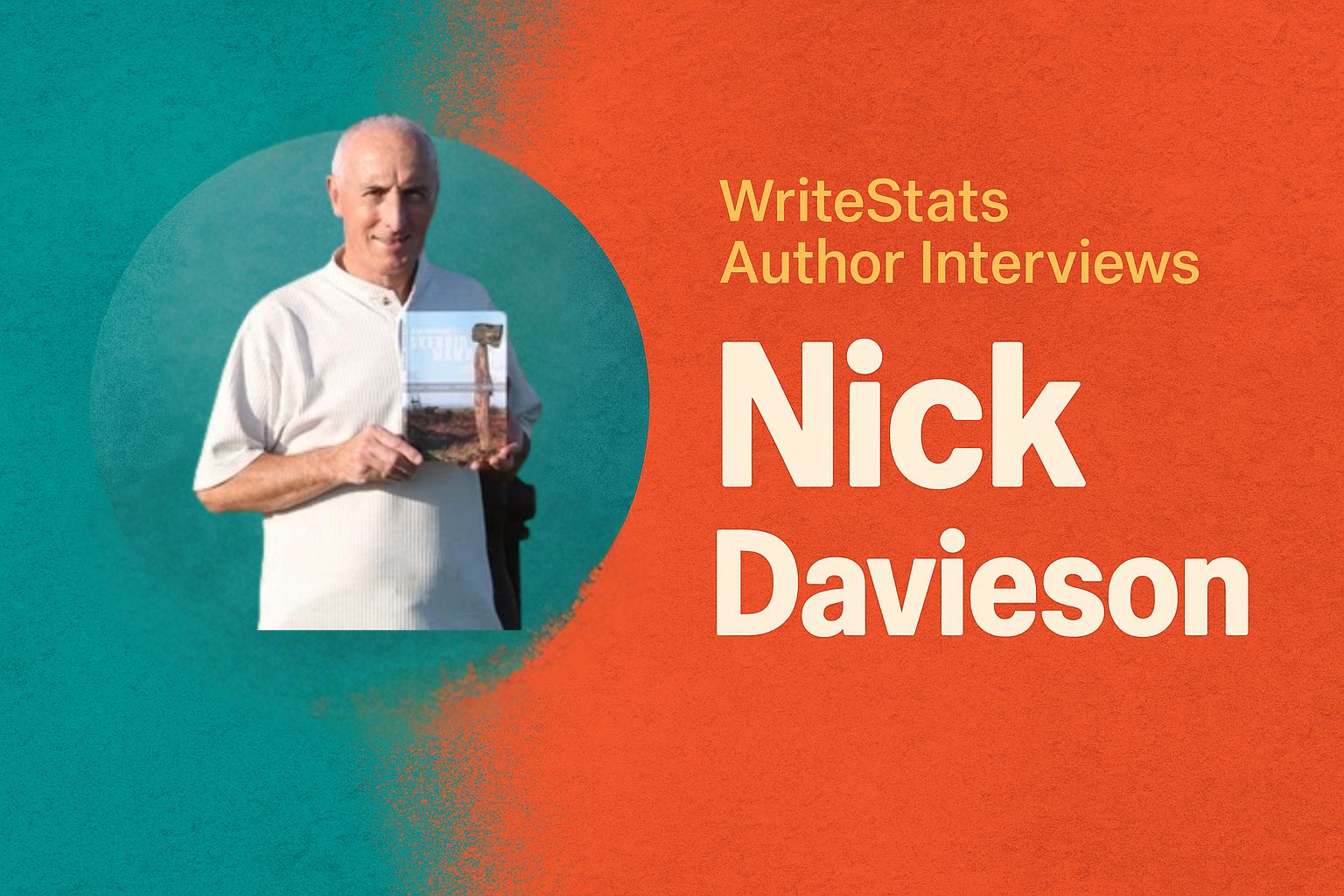
When Nick Davieson sat down to write his first novel in his sixties, he didn’t imagine it would find readers beyond his own circle. “The book was written by me for me,” he says with characteristic humility. “If anyone else enjoyed it—which they did—then that was a bonus.”
Yet his debut, Skerrid Mawr (Rowanvale Books, 2024), has done more than find an audience. It’s become a quiet success story for independent publishing in Wales, praised for its vivid sense of place and its unflinching treatment of middle age, body image, and liberation through naturism, a theme that’s deeply personal to the author himself.
Growing Up in a Theatrical Home: Early Creative Influences
Davieson’s creative roots stretch back to South East London in the 1970s, where his mother ran a travelling theatre company.
“My mother was a writer,” he recalls. “She started a travelling theatre company whilst I was fourteen years old. She wrote her own scripts, mostly aimed at primary school children.”
He remembers her hammering away at an old typewriter in the middle of the night, crafting scripts like The Water Babies.
“I’d wake up in the morning for school, only to find she’d gone off to some city, leaving a £10 note upon which myself and my brother were expected to survive. Luckily, we learnt how to cook!”
That early exposure to storytelling planted a seed, one that took decades to grow. “It took me a further forty years to start to consider writing a novel,” he admits. But when it came, it came with force.
Naturism, Wellbeing, and Writing as Catharsis
One of Davieson’s most striking influences came unexpectedly in midlife.
“I discovered naturism when I was in my mid-fifties,” he says. “My work took me near to a beach which was reportedly used by naturists. Work and domestic relationships had created stress in my life, so I took time out to visit the area. It proved to be the mental haven I was seeking.”
The experience reshaped his sense of self and his writing.
“I started to write short stories, for my own benefit, as a cathartic exercise. It snowballed from there.”
That honest exploration became Skerrid Mawr, a novel that uses the fictional Welsh coastal village as a backdrop for emotional reinvention. At its heart is Tam, a woman reclaiming her confidence and confronting past pain through the healing power of openness, nature, and community.
For Davieson, the theme goes beyond fiction.
“I hope that people are more open-minded about naturism,” he says. “Naturism, like any recreation, takes many forms. The improvement in my wellbeing has been greatly improved by experiencing naturism in a way that many are too afraid to venture into. It has nothing to do with sex or your sexuality.”
Craft, Collaboration, and the Value of Guidance
Despite describing himself as “not a proper writer,” Davieson’s process shows impressive structure and discipline.
“The biggest challenge is not having the skills to be what might be considered a ‘proper’ writer,” he admits. “I don’t have a degree in English Literature, nor do I read books on a regular or devout basis. However, that is why I pay others to guide me. I have the ideas, and they groove them for me.”
A key collaborator is his developmental editor, who Davieson says has become central to his motivation.
“Building a relationship with a Developmental Editor definitely helps. I tend to write the bulk of the novel and submit fairly early; it gives me a clearer direction on the second phase.”
While many debut authors are tempted by the latest writing tools, Davieson keeps it simple.
“I prefer to use Microsoft Word,” he says. “I know this is probably old school, but I don’t wish to waste valuable writing time learning other ways to work.”
Working With a Local Independent Publisher
Davieson chose to self-finance his publishing journey, spending around $3,750 on editing, design, and marketing. His decision to work with Rowanvale Books, a Welsh independent publisher, reflects his values.
“I always believe in spending my money with local small businesses,” he explains. “My own business was a small enterprise before I sold it, and it had always been a successful setup for me. They were always available to talk about all aspects of the book’s publication, which made it an enjoyable experience.”
The independent route was never a backup plan; it was his plan.
“I didn’t even contemplate approaching publishing houses or suchlike,” he says plainly. “It would be a waste of time and effort in my view, given the competitive marketplace that exists. It was always going to be an independent author avenue, self-financed.”
Why Nick Davieson Rejects AI in Creative Writing
In a world increasingly shaped by technology, Davieson stands firmly apart from the trend.
“I am against using AI tools,” he says unequivocally. “It is demeaning to authors. One gets the sense that every book is now considered to be AI-influenced, primarily to cut time and costs. It cuts quality, that is all it does.”
For him, writing is about genuine expression, not efficiency. His stance underscores a wider sentiment among traditionalist authors who view AI not as an aid, but as a threat to craft and authenticity.
Writing for Fulfillment, Not Financial Return
Davieson is refreshingly candid about his motivations.
“I do not depend on writing to earn my living,” he says. “After selling my business, I decided to use some of the money to fund the book and never expected a positive return on investment. I could have spent a huge amount of time and money on marketing the book, but I chose not to. That money could fund the follow-up instead.”
That follow-up, he reveals, is already well underway.
“The follow-up to Skerrid Mawr is a few months away from completion. Like Skerrid Mawr, the location is as important as the characters themselves. The style and feel of the book will remain true to myself; it will be based on my own observations of the world, entertaining, and a quick read.”
The Author as Everyman
Nick Davieson’s story resonates because it blends humility, independence, and personal transformation. He represents the late-blooming author archetype, proof that literary life can begin at any age, with or without formal credentials.
He’s not chasing bestseller lists or chasing algorithms. He’s simply writing stories that mean something to him, and, by extension, to others. As he puts it, “Most importantly, I don’t feel like an imposter in the marketplace. I know what I set out to do, and I am doing it.”
The Changing Landscape of Independent Fiction
Nick Davieson’s journey also echoes broader shifts in the publishing landscape. As we explored in our feature “Climate Fiction Is Booming in 2025: What It Means for Today’s Authors”, readers are increasingly drawn to authentic, place-driven storytelling that connects personal experience with global themes.
While climate fiction reimagines humanity’s relationship with the planet, Davieson’s Skerrid Mawr offers a more intimate form of ecological connection, rooted in the coastal rhythms of South Wales and the liberating power of nature. Both trends point to a growing appetite for fiction that feels real, grounded, and emotionally restorative.
Independent authors like Davieson, unbound by commercial formula, are uniquely positioned to meet that demand by writing the stories only they can tell.
🖋️ Lessons for Aspiring Authors Writing Later in Life
- Start when you’re ready. Davieson began writing fiction in his sixties and found his voice quickly.
- Invest in guidance. “I have the ideas, and they groove them for me,” he says of working with editors.
- Support local publishing. His partnership with Rowanvale Books shows how regional independents can nurture debut authors.
- Protect your authenticity. His anti-AI stance reminds us that storytelling remains a human craft.
- Write for fulfillment. “The book was written by me for me.”
Nick Davieson’s debut novel Skerrid Mawr is available through Rowanvale Books and online retailers.
His forthcoming second novel continues his exploration of place, identity, and personal rediscovery in modern Wales.