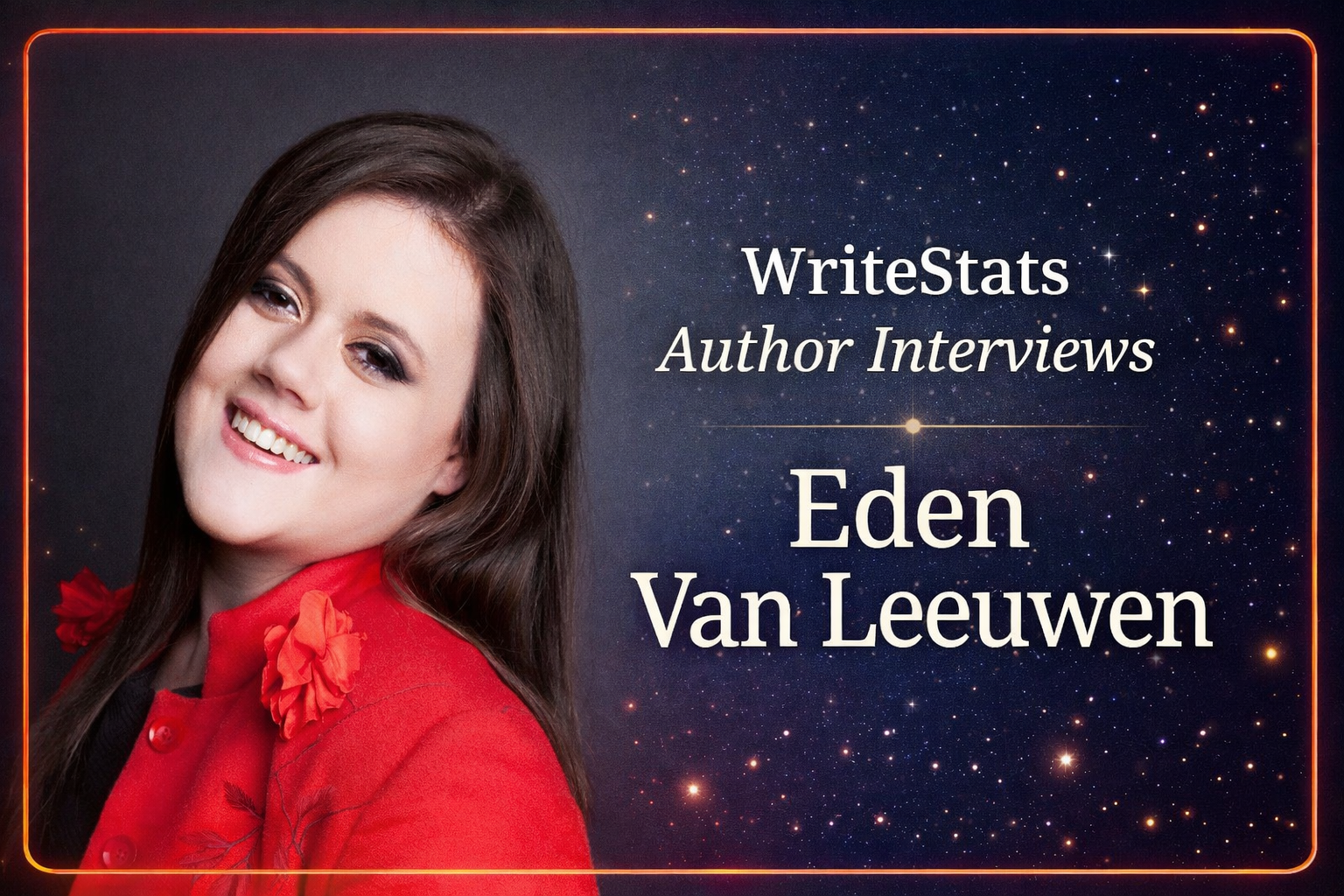
Before readers encounter her worlds of fantasy and psychological tension, they encounter voice: clear, deliberate, and deeply human. Eden Van Leeuwen is an Australian author, freelance writer, and proofreader whose work is shaped by lived experience, linguistic curiosity, and a strong commitment to creative autonomy.
Eden is the author of Fire Bringer, her debut novel, available in ebook, paperback, and audiobook formats. Alongside her fiction, she is an avid reader (averaging 50 books a year), a published writer beyond long-form fiction, and a creative professional currently working at ACMI, Australia’s national museum of screen culture.
In this WriteStats Author Interview, Eden Van Leeuwen opens up about her writing journey, the realities of independent publishing, the role of disability representation in fiction, and why finishing the story matters more than silencing self-doubt.
Finding Language Before Finding Stories
For Eden Van Leeuwen, writing didn’t begin with plot or character, it began with language itself.
“I could never find the words I needed to express myself. Through self-study in lexicology, I found a language for what I felt and that language slowly became stories.”
This origin story matters. It explains why Eden’s work places such emphasis on internal experience and emotional precision. Rather than writing around feeling, she writes through it. Consequently, her fiction becomes both narrative and translation, turning lived reality into something readers can access and understand.
Autism as Lens, Not Limitation For Eden Van Leeuwen
A defining influence on Eden Van Leeuwen’s writing is her autism diagnosis. However, she is clear that this influence is not incidental, it is foundational.
“My autism diagnosis shapes how I experience and understand the world. Through my writing, I seek to convey what it is like to live with a disability, creating space for awareness and empathy between people.”
In publishing data, authentic disability representation remains limited, particularly in genre fiction. Eden’s work pushes back against that gap. By centering autistic perspectives within speculative worlds, she contributes to a broader shift we’ve explored previously on WriteStats, especially in our earlier blog on How to Write Neurodivergent Characters Authentically: A Complete Guide for Authors.
Writing Through Resistance and Self-Doubt
Like many authors, Eden Van Leeuwen does not describe writing as effortless. In fact, her biggest challenge is one most writers quietly share.
“My biggest challenge is dealing with self-doubt. I work through it by continuing to write, keeping my focus on the end goal, and refusing to look back until the story is finished.”
That refusal to look back is key. From a productivity perspective, this aligns with what writing data consistently shows: forward momentum matters more than early perfection. Eden reinforces this with a simple but powerful reminder:
“Whenever I feel stuck, I remind myself that no one else can write this story the way I can.”
Tools, Process, and Reading Habits
Eden Van Leeuwen’s writing process is grounded in clarity and craft rather than complexity. She relies on familiar, accessible tools:
“Word and ProWritingAid.”
Just as importantly, she is a committed reader. Reading around 50 books per year places her well above the average adult reader, a pattern we repeatedly see among consistently publishing authors. Reading widely, she notes implicitly, feeds both technical skill and creative resilience.
Control, Cost, and Lessons Eden Van Leeuwen Learned
When it came time to publish Fire Bringer, Eden Van Leeuwen made a deliberate platform choice.
“I chose IngramSpark as my publishing platform, as it offers global reach while allowing me to retain full creative control.”
That control, however, came with responsibilities. Editing and proofreading were handled through trusted academic connections, while ebook conversion was outsourced due to technical confidence gaps.
“Due to limited confidence in transferring the book to an ebook format, I outsourced the conversion to Word-2-Kindle.”
Her total publishing budget came in at $1,500, covering editing, formatting, and production, an increasingly common range for independently published authors.
Despite responsive customer service, Eden is transparent about her overall experience:
“After I raised issues regarding errors in the books, they responded promptly and refunded the affected order.”
Do you recommend your publisher to other writers? “No.”
This kind of honesty is exactly what makes author interviews valuable to the wider writing community.
Full-Time Author, Long-Term Vision
Eden Van Leeuwen considers herself a full-time author, though not yet financially dependent on book income.
“None at this stage. My current goal is for my books to fund my lifestyle.”
This distinction matters. Publishing data shows many authors operate in this hybrid phase for years, balancing creative ambition with sustainable income streams.
On AI, Craft, and Humanity
Eden’s views on AI in publishing are nuanced but firm.
“Just as a crutch can help you walk, overreliance can cause your muscles to atrophy. A balance must be struck so AI supports the writing process without eroding your humanity, allowing you to continue growing as a writer.”
In an industry increasingly shaped by automation, her perspective emphasizes growth, agency, and craft, values that remain central to long-term creative success.
What Comes Next for Eden Van Leeuwen
Looking ahead, Eden is working on a new project that expands her thematic focus while pushing genre boundaries.
“My debut YA fantasy novel, THE WORLD UNSEEN, blends elements of mystery and psychological horror.”
“This story explores embedded ableism in society and features my own lived experiences as an autistic disabled person.”
If Fire Bringer introduced readers to Eden Van Leeuwen’s voice, The World Unseen promises to deepen it—both narratively and culturally.
The Legacy She’s Writing Toward
When asked what she hopes her writing will ultimately leave behind, Eden’s answer is clear and consistent with everything she creates:
“I hope to create greater empathy and understanding for people with autism through my writing.”
In a publishing landscape increasingly driven by data, discoverability, and speed, Eden Van Leeuwen reminds us why stories matter in the first place: they change how we see each other.