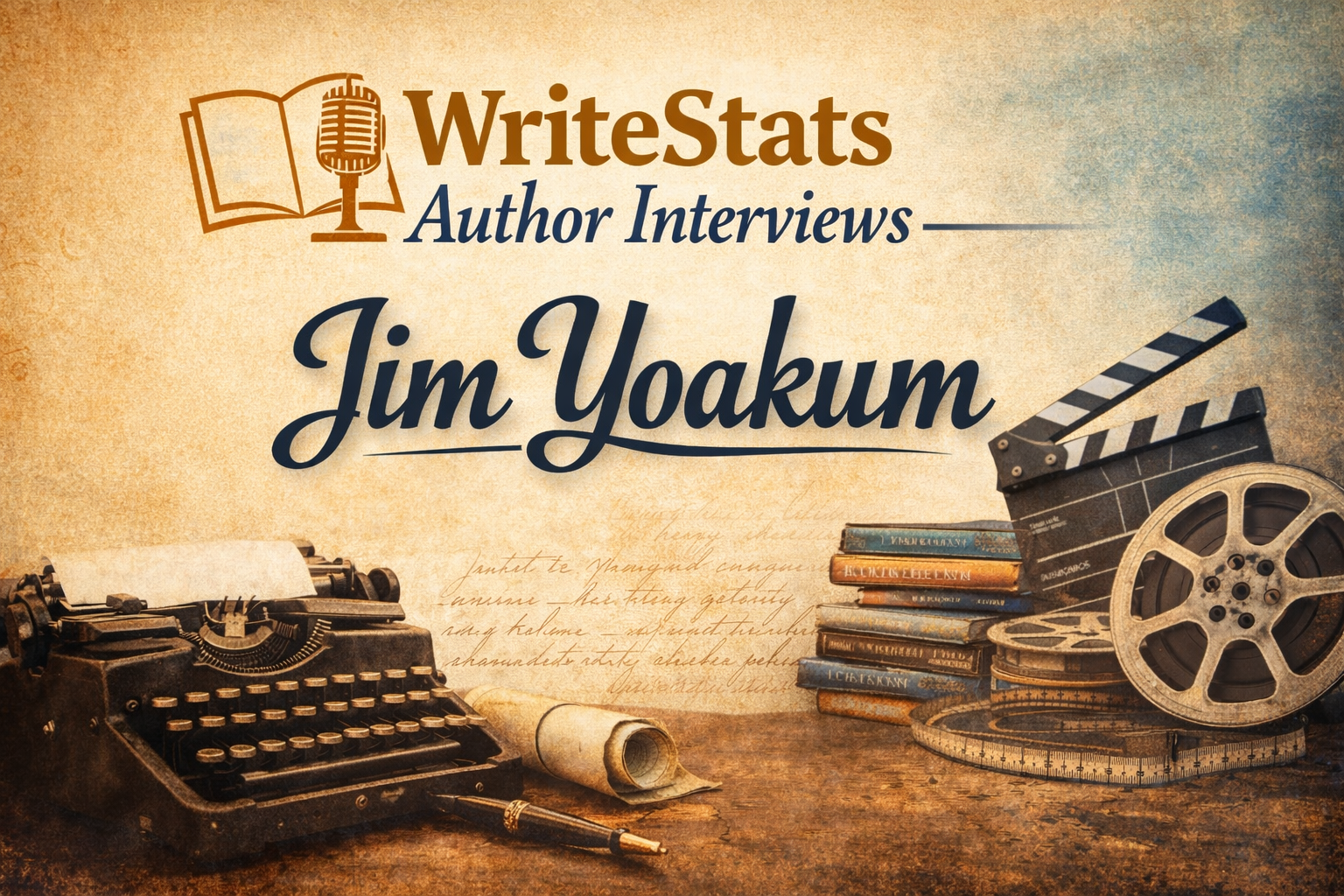
When you look at Jim Yoakum’s career, one thing becomes immediately clear: this is not a writer experimenting with the craft, this is a writer who has lived inside it for decades.
Born April 12, 1958, and based in the United States, Jim Yoakum has published 30 books and built a career spanning novels, non-fiction, screenwriting, journalism, and archival curation . In addition to his books, Yoakum has written for outlets such as Rolling Stone, The Onion, and Goldmine, and has screenwriting credits for produced films. He has also served as a curator of the Graham Chapman Archives and as Senior Advisor and Project Consultant to the Terry Southern Literary Trust, roles that place him at the intersection of literature, satire, and cultural history.
Yet despite the credentials, Yoakum’s perspective on writing is refreshingly blunt.
Jim Yoakum Started Writing at 10, and Never Stopped
When asked how his journey began, Jim Yoakum’s answer was strikingly simple:
“When I was 10.”
That early start tracks with what publishing data shows us repeatedly: professional longevity often begins with early creative immersion. Writers who start young don’t just practice craft, they internalize narrative structure before they ever think about marketability.
And who shaped his voice?
“Graham Greene, Joseph Heller.”
It’s a revealing pairing. Greene’s moral complexity and Heller’s absurdist satire both echo in Yoakum’s sensibility, particularly given his archival connection to Graham Chapman and his broader literary orbit.
Writing as Compulsion, Not Motivation
Many writers talk about discipline. Others talk about inspiration. Jim Yoakum reframes the entire conversation.
When asked what keeps him writing when it gets hard:
“It’s compulsion.”
That distinction matters.
In our analysis of career authors, intrinsic drive consistently outperforms external motivation. Compulsion suggests inevitability. And inevitability sustains output.
He reads around 10 books per year, a modest but steady input stream. Notably, high-volume publishing doesn’t always correlate with extreme reading volume. Often, it’s about focused consumption paired with consistent production.
“Mainstream Publishing Is Dead”
Here’s where the Jim Yoakum interview turns sharp.
On his experience with his publisher:
“Fine, but mainstream publishing is dead.”
That’s not hyperbole, it’s a sentiment increasingly echoed across the industry. While traditional publishing still dominates prestige channels, discoverability and distribution are being reshaped by digital ecosystems.
He chose his publishing platform based on one factor:
“Ease.”
And his total publishing budget for his last book?
“0.”
Zero-dollar production is rare but revealing. It underscores a larger shift: barriers to entry have collapsed. However, as we explored in How To Beat Publishing Odds: Only 1–2% of Manuscripts Get Published, access does not equal visibility. Production is easier than ever. Distribution remains the true hurdle.
A Full-Time Author: But Writing Is “Walking Around Money”
Jim Yoakum considers himself a full-time author . Yet when asked how much he depends on writing books for income:
“It is walking around money.”
This is one of the most honest financial framings we’ve seen.
For many career writers, income is diversified: screenwriting, journalism, consulting, archival roles. The romanticized image of a novelist living solely off book royalties simply doesn’t align with industry earnings data for most authors.
In fact, sustainability often comes from adjacent creative revenue streams, something Yoakum’s career clearly reflects.
Diversification: The Hidden Career Strategy
One of the most revealing parts of the Jim Yoakum interview is how his income ecosystem functions.
He’s a novelist.
He’s a screenwriter.
He’s written for national publications.
He’s held advisory and archival roles.
That diversification matters.
When Yoakum says writing books is “walking around money”, it reframes expectations. Books build brand equity. Surrounding creative work builds stability.
For emerging writers, this isn’t discouraging, it’s strategic clarity.
The Hardest Part of Writing? “Stopping.”
When asked about his biggest challenge:
“Stopping.”
Not starting. Not discipline. Not doubt.
Stopping.
That answer hints at a writer whose challenge isn’t productivity, it’s containment. And that creative overflow often correlates with longevity. As we explored in How to Write Entertaining Books: 1 in 4 Readers Read for Pure Enjoyment, sustained creative output increases the odds of producing high-enjoyment work because experimentation compounds.
Jim Yoakum on AI in Publishing
On using AI in editing, cover design, analysis, or marketing:
“I am with using AI.”
“They are a tool that’s all.”
This pragmatic stance mirrors broader industry adoption trends. AI tools are increasingly used for efficiency, but they remain exactly that: tools.
Writers who treat AI as augmentation rather than replacement tend to integrate it more sustainably. And sustainability, as we’ve shown in our research on universally marketable storytelling, often wins long term.
The Legacy: “Laughter”
Perhaps the most telling answer of the entire Jim Yoakum interview came at the end.
What legacy does he hope his writing leaves?
“Laughter.”
In an industry obsessed with algorithms, sales ranks, and category positioning, that answer feels almost radical.
Yet it aligns directly with reader behavior data. Emotional payoff, especially joy and humor, is one of the most powerful retention drivers in fiction. As we discussed in What Makes a Story Universally Marketable And How You Can Build One, emotional clarity often outperforms genre trends.
Yoakum’s upcoming project?
“About how rock n roll was invented in 1820.”
Absurd. Playful. Unexpected.
Exactly on brand.
What Writers Can Learn from Jim Yoakum
The Jim Yoakum author profile offers several data-aligned takeaways:
- Longevity often begins early: start now, refine later.
- Compulsion sustains output better than motivation.
- Ease in publishing lowers barriers, but visibility still demands strategy.
- Income diversification is often the real career model.
- AI is leverage, not identity.
- Emotional impact outlasts platform shifts.
Ultimately, Jim Yoakum’s career reminds us that while publishing models evolve, the core remains the same: write consistently, adapt pragmatically, and aim for emotional resonance.
Or, in his words:
“Laughter.”
And sometimes, that’s the most marketable strategy of all.
For more data-backed insights on writing, publishing, and author growth, explore our latest research at WriteStats.