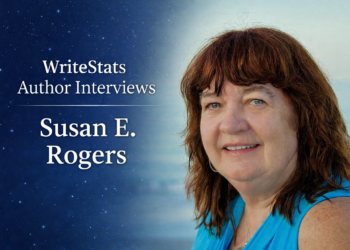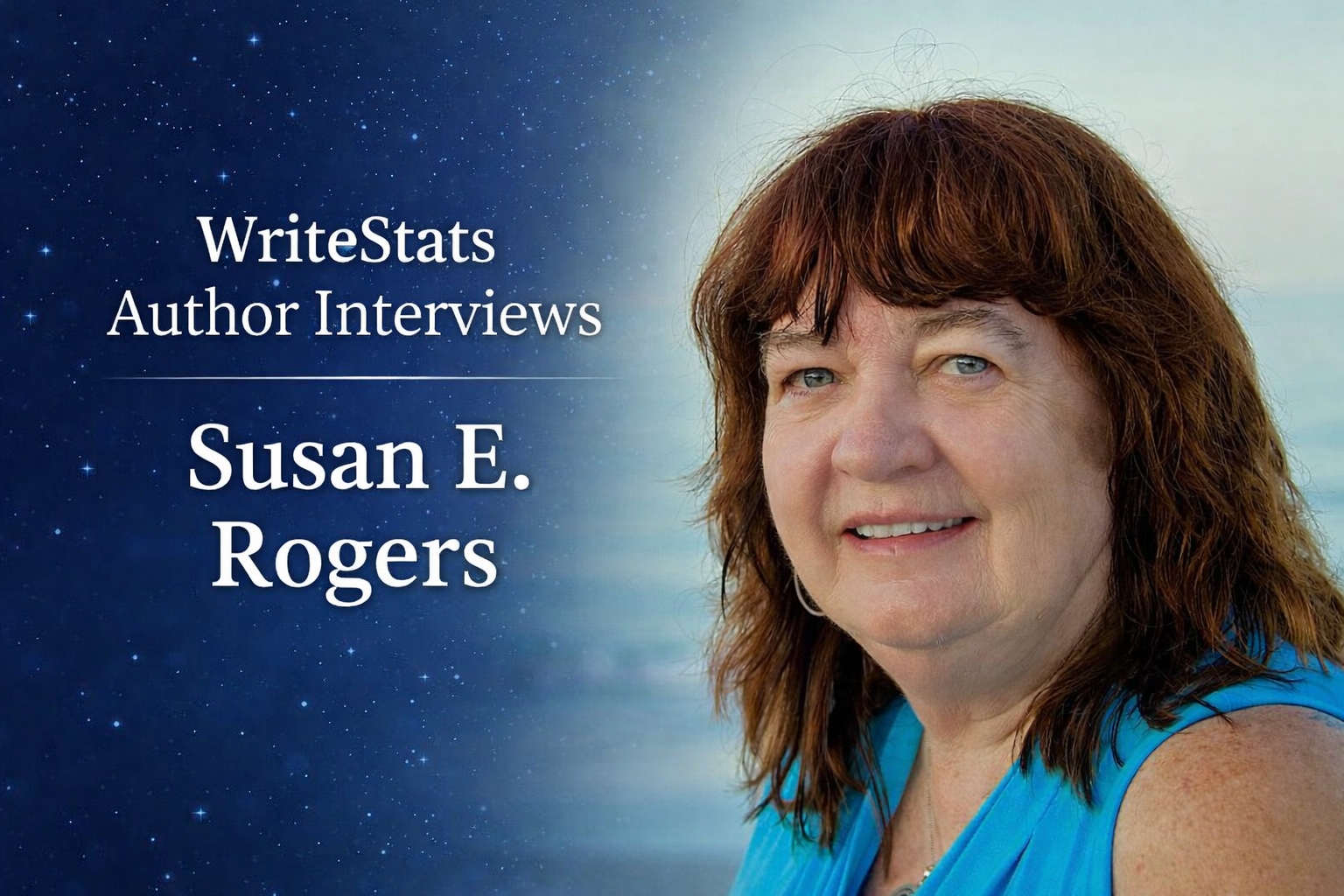
Before diving into our interview, it’s important to understand who Susan E. Rogers is and why her voice matters in today’s publishing landscape. Susan is a U.S.-based author of speculative fiction, horror, and thrillers whose work consistently explores memory, fear, history, and the supernatural. She is the author of five books, including Death in the Cards, Haunted in Paradise, Uncovering Norman: Proving the Former Life of a Ghost, Lady, Will You Hear Me?, and The One‑in‑the‑Noose. Her stories frequently blend atmospheric horror with meticulous research, creating narratives that stay with readers long after the final page.
In this edition of the WriteStats Author Interview Series, Susan E. Rogers shares her journey as a writer, her experiences with traditional publishing, her firm stance on AI in creative work, and the legacy she hopes her stories will leave behind. As with many of our recent WriteStats interviews, her responses also contribute to our ongoing research into how authors write, publish, and sustain creative lives over time.
A Storyteller from the Very Beginning
Susan E. Rogers’ writing journey began long before publication or queries entered the picture. As she explains, storytelling was part of her identity from childhood.
“I was a storyteller as a young child, reciting my tales to my imaginary friends.”
Eventually, that love of storytelling found a more private outlet. During high school, she began writing poetry and short stories, although she kept them largely to herself.
“Writing started with poetry and short stories in high school that I put away in a folder and never showed anyone.”
This early relationship with writing—intimate, exploratory, and self‑directed—is something we’ve observed repeatedly across many WriteStats interviews. For Susan E. Rogers, writing was never about external validation at first; instead, it was about the joy of creating worlds and voices.
Literary Influences and a Love for the Dark
Unsurprisingly, Susan E. Rogers’ influences align closely with the genres she writes today. She describes herself as a lifelong reader drawn to darker, atmospheric stories.
“I have always been an avid reader, and have always been drawn to dark stories—thrillers and mysteries, along with atmospheric and paranormal horror.”
She cites classic Gothic and mystery authors as foundational influences, including Edgar Allan Poe, Wilkie Collins, and Arthur Conan Doyle. At the same time, more modern voices also helped shape her style.
“More modern authors whose style has influenced mine are Stephen King, Peter Straub, and Dean Koontz.”
This blend of classic Gothic sensibility and contemporary horror storytelling is evident throughout Susan E. Rogers’ body of work, where mood, pacing, and psychological tension take center stage.
Staying Motivated When Writing Gets Hard
Like many authors, Susan E. Rogers acknowledges that writing isn’t always easy. However, her motivation comes from a simple but powerful source: love of the craft.
“I just love to write! And I love to tell stories.”
When she encounters creative resistance, she doesn’t force it. Instead, she steps away strategically.
“If I get stuck at any point in a story, I give it some time away, maybe work on another piece, or some other diversion, to give my imagination room to work on its own.”
She adds that this approach usually works quickly.
“In a day or two, I’m back at it.”
This flexible, patient mindset echoes advice we’ve explored in previous WriteStats articles on creative burnout and long‑term productivity.
Tools, Process, and Reading Habits
Despite writing speculative and supernatural fiction, Susan E. Rogers keeps her tools refreshingly straightforward.
“I write in MS Word. I use a thesaurus and Google (without AI). I also read books for research while I’m writing.”
She reads approximately 20 books per year, reinforcing the strong correlation we often see between consistent reading and sustained writing output. For Susan E. Rogers, research and reading are not optional extras; they are essential parts of her creative process.
The Reality of Traditional Publishing
Susan E. Rogers’ publishing journey offers valuable insight into the realities of traditional publishing today. For her first publishing offer, she sent a total of 42 queries.
“I started querying both agents and publishers in March 2020.”
The timeline was long and required patience.
“The book, Haunted in Paradise, was accepted in Jan. 2023, released in Oct. 2025, a year later than originally planned by the publisher.”
While the process included delays and communication challenges, she reflects on it with nuance.
“There were a few glitches and hold‑ups on the publisher’s end, and it slowed down the process. I felt there could have been better and more regular communication.”
Still, the final result mattered.
“Overall, however, I was satisfied with the publisher… They did a great job with editing, formatting, cover, etc. and I am really happy. My book looks great.”
She confirms that she would recommend her publisher to other writers, a data point we’ll include in our upcoming WriteStats Publishers Directory.
Writing, Income, and Age Bias
Susan E. Rogers considers herself a full‑time author, though not in the financial sense.
“I am retired and do not expect my books to generate or contribute any substantial amount to my income.”
One of the most striking parts of her interview addresses age bias in publishing, a topic that continues to surface across our research.
“When I started trying to publish, age bias became immediately clear.”
She explains how she adapted pragmatically.
“I took any reference to my age out of my bio, making it age neutral. This helped.”
Today, she feels more confident.
“I’m not so concerned about it anymore, since I feel my writing credentials now speak for my ability as a writer.”
A Firm Stance on AI in Writing
Susan E. Rogers is unequivocal when it comes to artificial intelligence in creative work.
“I am against using AI tools.”
She expands on this belief clearly.
“Absolutely, NO! If you have a talent and ability for writing, there’s no need. The creative process is a human one, and one that I believe cannot be recreated through AI.”
Her perspective aligns with broader debates we’ve examined in recent WriteStats blogs on AI, authorship, and creative authenticity.
Legacy and What Comes Next
When asked about the legacy she hopes to leave, Susan E. Rogers answers with quiet emotional clarity.
“I hope my stories will impact at least a few readers, and remain in their memory.”
She continues:
“That the feelings and emotions evoked by my words will be internalized and remembered. That a few of my books will be found on some shelves, long after I’m gone.”
Looking ahead, she is already deep into her next project—a historical horror novel set aboard a possessed whaling ship.
“It is a historical horror tale about a possessed whaling ship, diving deep into historical research on the whaling era.”
Her tagline captures the ambition perfectly.
“If Herman Melville invited H.P. Lovecraft and Homer to dine on the whaleship Essex, imagine the tale the three of them could weave.”
Final Thoughts
Susan E. Rogers’ interview is a powerful reminder that writing careers are rarely linear, quick, or easy, but they can be deeply meaningful. Her dedication to craft, research, and emotional impact reflects many of the patterns we continue to uncover through the WriteStats Author Interview Series.
Authors like Susan E. Rogers show that persistence, patience, and creative integrity matter just as much as speed or trends. Her work and her words are proof that stories written with care can endure.