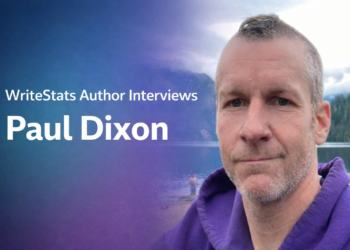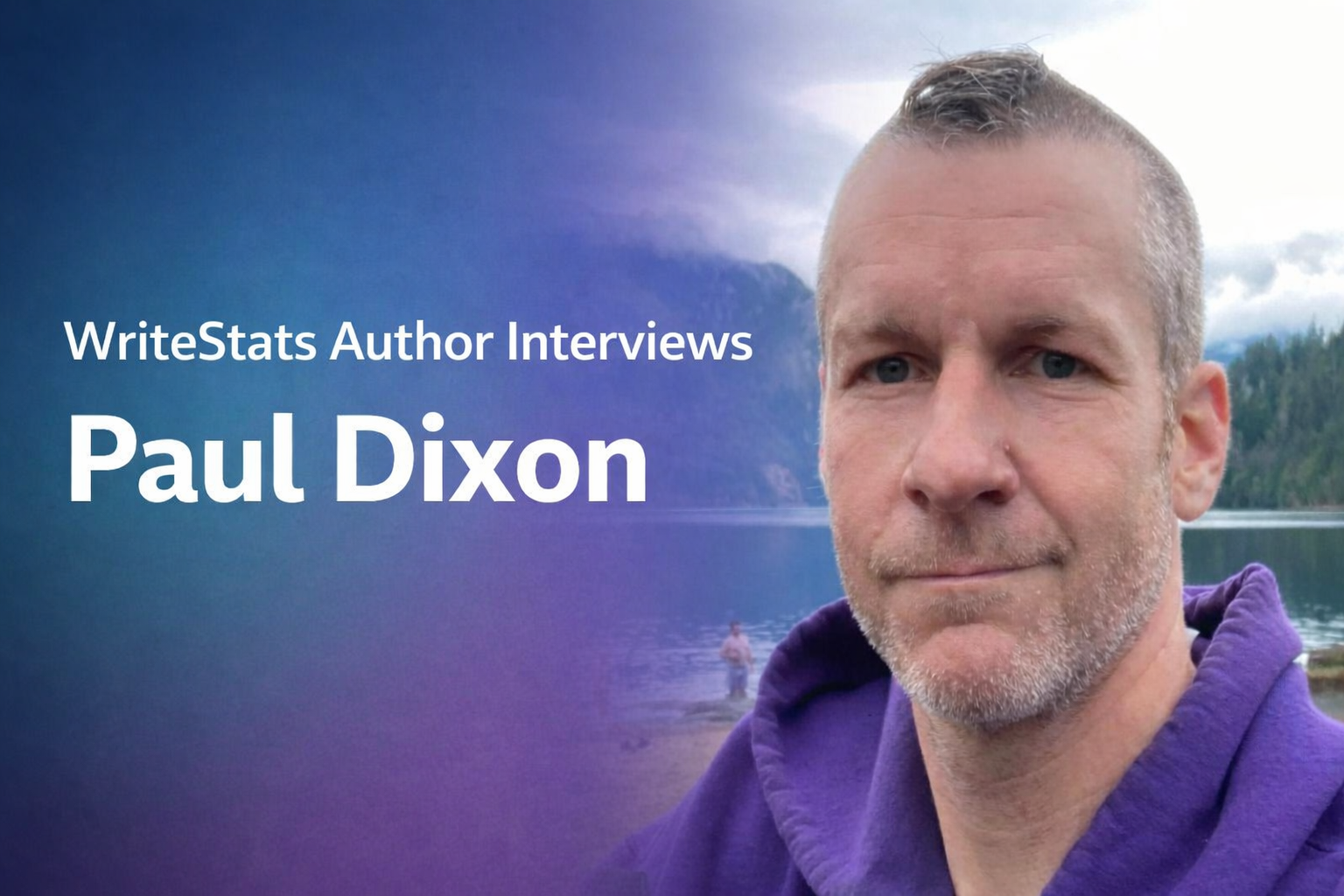
At WriteStats, we spend a lot of time analyzing how writers work, their habits, tools, motivations, and long-term trajectories. Few interviews embody those themes as clearly as our recent conversation with Paul A. Dixon, a science fiction and fantasy author whose career bridges hard SF, YA fantasy, and short fiction, all while maintaining a demanding career in climate tech.
In this in-depth interview, Paul Dixon speaks candidly about writing as a lifelong practice, the patience required to build ambitious worlds, and the importance of staying human in an increasingly automated publishing landscape. Below, we introduce the author and his books, then dive into his own words because, as he puts it, “we need art in our lives.”
Who Is Paul Dixon? Author, Climate Technologist, Lifelong Storyteller
Paul Dixon is a U.S.-based science fiction and fantasy author with five published books across multiple genres. By day, he works at a climate technology startup focused on power grid decarbonization. By night—and, more accurately, every morning—he writes.
His bibliography includes:
- Carpathians: a large-scale hard science fiction novel centered on deep time, corporate expansion, and first contact
- An Occurrence at Owlskirk: a speculative short story collection blending SF, magic realism, and metafiction
- Starfall, Moonfall, and Sunfall: a YA fantasy trilogy written under PA Dixon
This dual identity shows up clearly in his work. Authors who sustain parallel careers often bring a distinctive rigor to their fiction. Paul Dixon is a textbook example.
“I’ve Been Writing My Whole Life”: How Paul Dixon Began
When asked how his writing journey started, Paul Dixon traced it all the way back to middle school.
“I remember being given a short-story writing assignment as a sixth grader. I decided to write one of those choose-your-own adventure books that were popular back then… It was called ‘Exploring Fleet No. 1,’ and there is an (alarmingly) obvious straight line connection from it to the science fiction I write today.”
That straight line matters. Data consistently shows that writers who identify as “lifelong” storytellers tend to persist longer through rejection and slow growth. In Paul Dixon’s case, that persistence culminated in Carpathians, a novel he worked on slowly for years before publication.
Influences: Standing on the Shoulders of Giants
Like many SF authors of his generation, Paul Dixon grew up immersed in genre classics.
“My parents had copies of Foundation and Dune on their bookshelves… Tolkien, McCaffrey, Zelazny, Heinlein, Bradbury, Clarke, and then a little later David Brin, who had an enormous impact on me.”
Importantly, this isn’t nostalgia; it’s lineage. His work reflects what we often highlight in our WriteStats analysis of genre evolution: modern science fiction frequently extends the questions posed by earlier writers, especially around civilization, technology, and time.
Writing as Practice, Not Performance
One of the most striking insights from Paul Dixon is how he frames writing itself.
“Writing for me isn’t work, it’s a practice… It is the first thing I do when I wake up in the morning, essentially every morning.”
Consistency, he explains, removes pressure rather than adding it.
“Consistency depressurizes the whole thing, because I know for certainty that I’ll be back at it again tomorrow.”
From a data perspective, this aligns closely with what we’ve documented in our WriteStats posts on daily writing habits: frequency matters more than session quality, especially over multi-year projects.
Tools, Process, and the Reality of Publishing
Paul Dixon is refreshingly pragmatic about tools.
“I use Scrivener for early-stage composition and Vellum for final formatting… Grammarly for basic readability along the way, but final copy-edits are the work of humans.”
He also notes that practical challenges , like print cover formatting, often surprise first-time authors more than the writing itself.
Indie Roots, Traditional Reach
Although Paul Dixon began as an indie author, his career evolved organically.
“I started off indie… and then was approached by Podium about doing an audiobook for my novel Carpathians.”
Of that experience, he’s unequivocal:
“Podium is fantastic… my main contact had read it, and clearly believed in it.”
This hybrid path, indie launch followed by selective traditional partnerships. is increasingly common.
On Focus, Endurance, and the Attention Economy
Despite years of experience, Paul Dixon names focus as his biggest challenge.
“We live in the age of attention span fragmentation and dopamine addiction… it gets harder and harder to get back into the flow state.”
His solution isn’t hacks or optimization, it’s ritual. Again, the data agrees: writers who rely on routines rather than motivation show higher long-term output stability.
A Firm, Thoughtful Stance on AI
Paul Dixon doesn’t hedge when it comes to AI in publishing.
“I am largely against the use of AI in the writing and publishing process.”
While he acknowledges limited use for copy editing and research, his core objection is cultural.
“As writers, it is our job to do more than employ statistical models of what has been written before.”
It’s a perspective that adds important nuance to ongoing conversations we’ve covered on WriteStats about AI adoption across publishing.
Legacy, Time, and What Comes Next
When asked what he hopes his writing leaves behind, Paul Dixon returns to scale.
“Carpathians is all about timescales… the solemn power and utter necessity of being able to plan for longer time horizons than we currently do as a species.”

Still, his final answer is deeply human:
“We need art in our lives… It’s what it means to be human.”
He’s currently working on the sequel to Carpathians, targeting early 2027.
Why Paul Dixon’s Career Matters
From a WriteStats perspective, Paul Dixon represents a powerful data-backed truth: sustainable writing careers are built on practice, patience, and principle, not speed or shortcuts.
His journey reinforces patterns we see again and again about long-term creative endurance in a rapidly changing publishing ecosystem.
📊 For more insights like this, explore other interviews and research articles on WriteStats, where storytelling meets data.