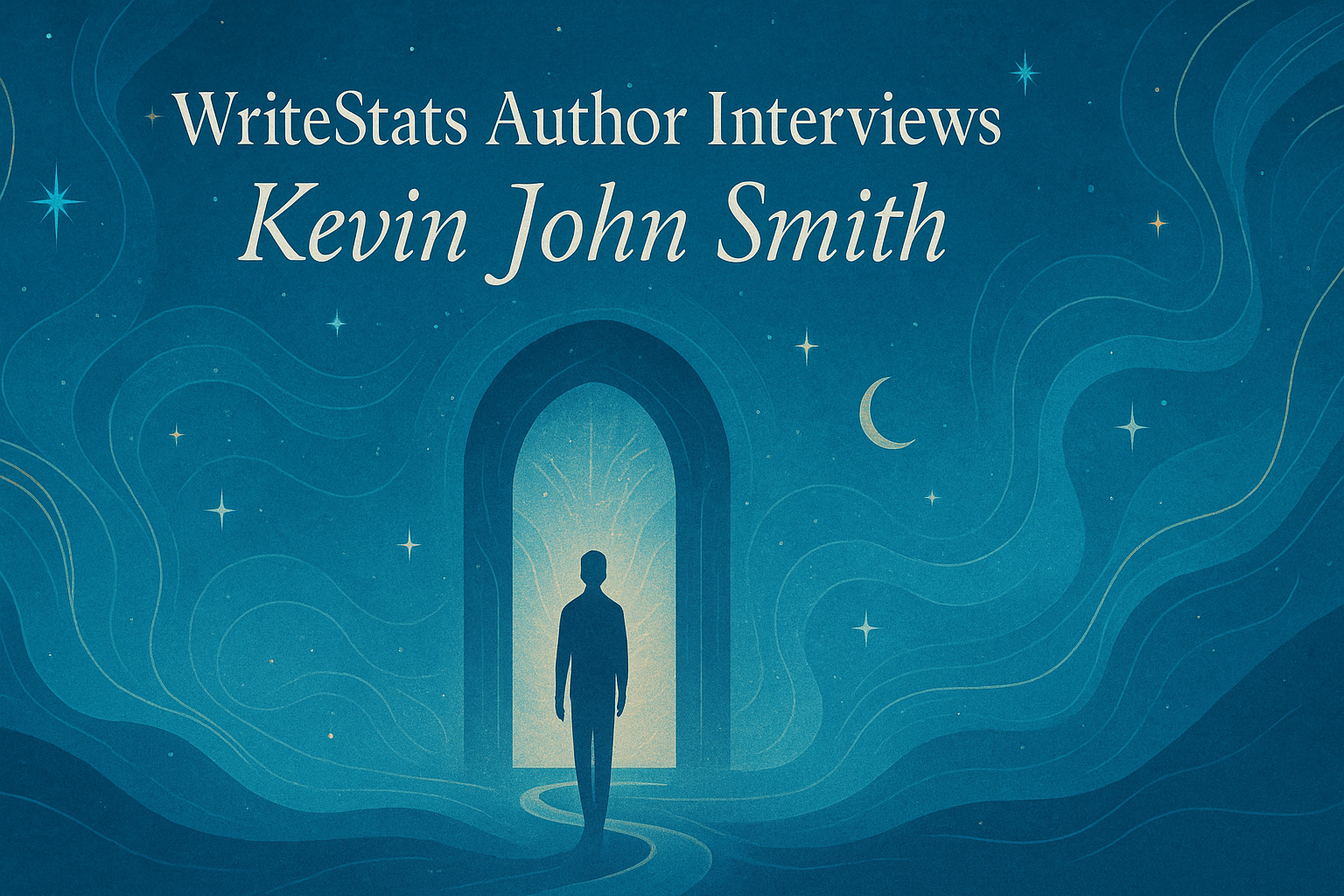
In today’s feature from our WriteStats Author Interviews, we spotlight Kevin John Smith, a Canadian author whose work blends spiritual fiction, metaphysical exploration, and profound compassion for humanity. His debut novel, Ryan’s Odyssey, introduces readers to a story shaped by questions of creation, transcendence, and the potential for a global energetic shift.
Kevin John Smith describes himself as someone who has “written stories for many years, as a hobby” before deciding to bring his first book into the world. His author journey reflects something we often see among purpose-driven writers: a deep need to communicate ideas that uplift, heal, and provoke reflection.
Today, we explore his creative philosophy, his writing process, his views on publishing and AI, and the legacy he hopes his work will leave behind.
Introducing Kevin John Smith and Ryan’s Odyssey
Before we dive into the interview itself, let’s take a closer look at Kevin and his work.
Kevin John Smith is an author of new age and spiritual fiction, writing stories that blend adventure with higher-consciousness themes. His debut novel, Ryan’s Odyssey, is available on Amazon and published under his independent imprint, Nahannigate Publishing, which he created specifically to bring this book to life.
He describes his lifelong creative interest as rooted in “the origin of creation, and the capacity of transcendence for the human race.” These themes are the backbone of Ryan’s Odyssey, a novel that seeks to inspire readers while exploring humanity’s potential for deep, energetic and emotional transformation.
Readers who enjoy fiction with philosophical undertones and optimistic messages will be drawn to his work.
His influences include classics such as:
- Tales of the South Pacific
- Grapes of Wrath
- Lost Horizon
These choices reveal a love for expansive landscapes, emotionally rich storytelling, and narratives that question the deeper forces shaping human experience.
Kevin John Smith: A Creative Journey Rooted in Hope and Transcendence
When asked how his writing journey began, Kevin explained that writing had always been part of his life, though quietly:
“I have written stories for many years, as a hobby. I recently decided to actually finish this book and publish it.”
Many authors will relate to this moment. The story lives inside you for years, simmering, until one day something shifts and you finally decide: It’s time.
For Kevin, that spark came from a desire to convey meaningful truths. He shares:
“I have always been interested in the origin of creation, and the capacity of transcendence for the human race.”
This foundational curiosity guides every aspect of his writing. His books aim to inspire and offer new ways of seeing the world, combining narrative with intention.
Writing with Purpose: The Themes That Drive Kevin John Smith
When writing becomes difficult, Kevin says his motivation comes from a deep internal calling:
“The desire to communicate positive ideas and concepts.”
In a literary landscape filled with darkness, cynicism, and high-stakes conflict, Kevin’s approach stands out. His fiction is grounded in hope rather than despair, in transcendence rather than nihilism, and in the belief that humanity can rise to something better.
This aligns beautifully with what we explored in our WriteStats article, What Makes a Story Universally Marketable, And How You Can Build One.
One of the core principles in that piece is that stories rooted in universal emotional truths resonate widely. Kevin’s novel does exactly this by exploring hope, compassion, courage, and spiritual evolution. Themes that cross cultural and demographic boundaries.
The Creative Tools Behind the Writing
Kevin keeps his writing process simple and grounded:
“Basic word processing and Adobe.”
In a time of complex software and AI-driven writing tools, his process mirrors the purity of his message. No elaborate systems. No overstimulation. Just words, ideas, and the intention to communicate something meaningful.
He also reads an average of ten books per year, a respectable number that keeps his creative well replenished while giving him time to build stories of his own.
Kevin John Smith on Publishing: Independence, Accessibility, and Integrity
Kevin chose to self publish on Amazon, explaining:
“I self published on Amazon because I have not found a publisher. I started Nahannigate Publishing to publish my book.”
His choice reflects a familiar truth for many modern authors: traditional publishing can be slow and gatekept, but self publishing provides accessibility, autonomy, and control.
When asked why he chose Amazon specifically, he said:
“Accessibility, both for me and for readers.”
That’s one of the strongest advantages of KDP. Anyone, anywhere, can discover your book within minutes of publication.
Kevin used pagination software to prepare his book and says he would recommend his approach to other writers.
On Writing Full Time and the Biggest Creative Challenge
Interestingly, Kevin considers himself a full-time author, even though he does not depend financially on his writing:
“Not at all.”
This distinction separates profession from identity. For Kevin, authorship is not about income. It is about vocation.
When asked about his biggest challenge, he shared:
“Inspiration. I try to practice transcendence.”
This is a striking reflection. Instead of forcing ideas or pushing productivity, he seeks a state of clarity and elevated perspective. His approach mirrors the spiritual themes embedded in his fiction and offers a valuable reminder: creativity thrives when we rise above noise rather than sink into it.
Kevin John Smith on AI in Publishing: A Clarified, Nuanced Stance
Kevin is refreshingly candid about AI:
“I am against using AI tools.”
Yet he also acknowledges exceptions:
“Generally I am opposed to using AI, but of course there are exceptions.”
His position is not rooted in fear, but in ethics and intention. He values human originality, emotional intelligence, and authenticity. His reluctance toward AI also aligns with his mission: communicating positive, purposeful concepts that come from lived experience, not machine synthesis.
In many ways, his stance highlights a crucial discussion in today’s publishing landscape. Authors must now balance innovation with integrity. Kevin’s voice reminds us that human storytelling still holds irreplaceable value.
The Legacy Kevin John Smith Hopes to Leave
When asked about the mark he hopes his writing will leave, Kevin offered one of the most striking quotes of this entire interview:
“I hope to offer inspiration and hope for people. I wrote this book to illustrate the possibility for a seismic shift in the energy of our world, and the potential for positive change.”
“Men can be strong, brave and tough, while simultaneously being kind, compassionate and sensitive… none of these is mutually exclusive.”
This is the heart of Kevin’s work.
He writes not just to entertain, but to heal.
Not just to tell stories, but to elevate consciousness.
Not just to examine humanity, but to reimagine it.
This message is universal, powerful, and deeply needed.
What’s Next for Kevin John Smith
Kevin is already working on his next novel:
“It is about an eccentric individual who has a plan to rearrange the world around him.”
The premise fits perfectly into his storytelling identity: characters who challenge perception, question reality, and attempt to alter the world’s energetic or philosophical landscape.
Readers who enjoy transformative fiction with spiritual undertones will want to watch this upcoming project closely.
Final Thoughts: Why Kevin John Smith’s Voice Matters in Today’s Publishing Landscape
Kevin John Smith is more than an author. He is a storyteller with purpose, a voice of optimism, and a writer committed to inspiring transcendence in his readers.
At a time when the world feels chaotic and divided, authors like Kevin offer something rare and necessary: fiction that lifts rather than fractures, heals rather than harms, and invites readers to imagine a more harmonious and compassionate future.
If you enjoy thoughtful, spiritually rich narratives, keep Kevin John Smith on your radar. His work is only just beginning.