Writing Horror From Darkness: Creativity After Vision Loss
When it comes to storytelling born from both darkness and determination, few authors embody that duality like Matthew R. Taylor. Born in the United States, Taylor is a horror author and poet renowned for his ability to craft chilling, emotionally charged worlds that linger long after the last page.
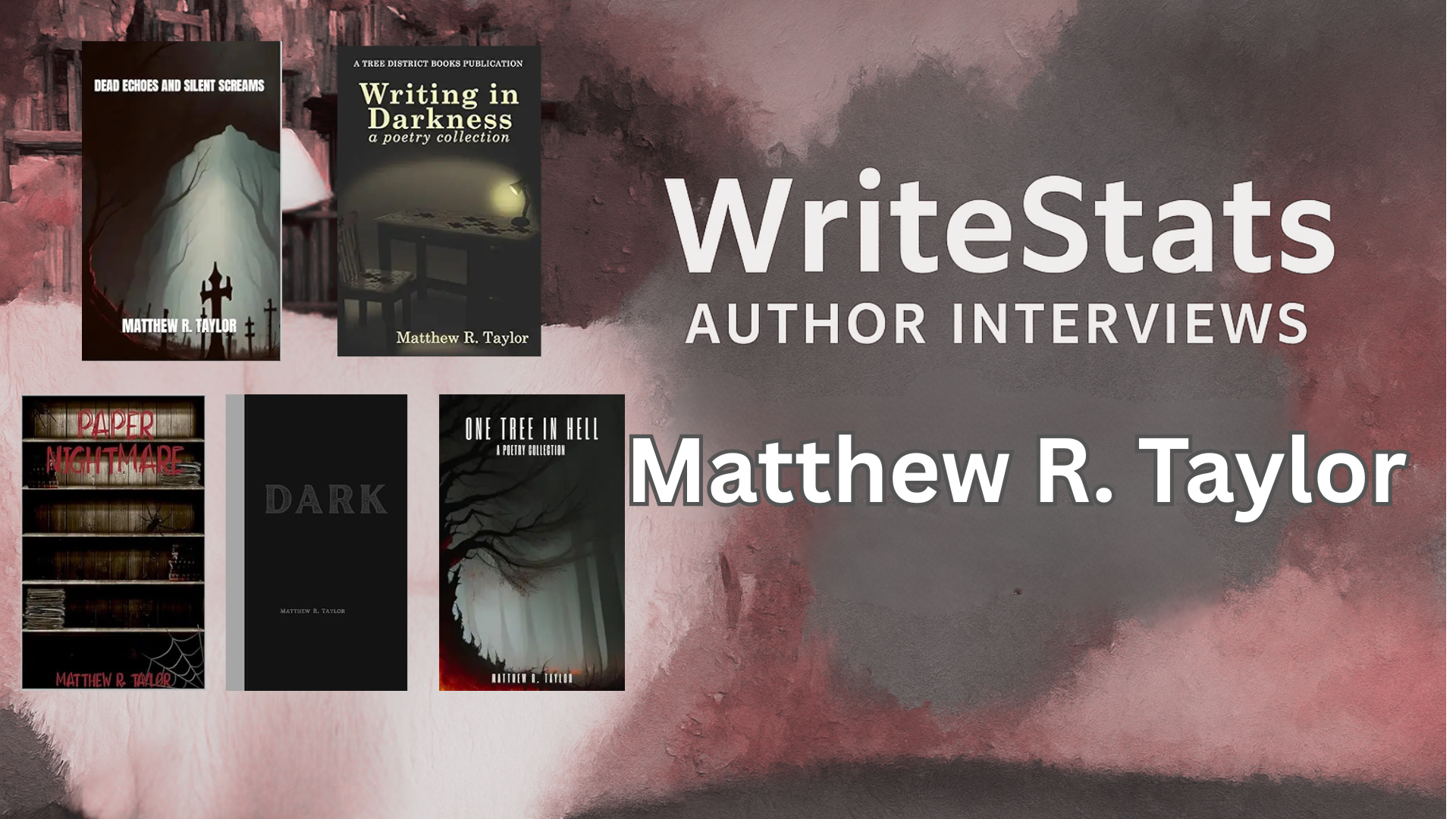
Blind since his 30s due to a genetic eye disease, Taylor has transformed personal adversity into creative energy. His catalog, including Dark, Paper Nightmare, Dead Echoes and Silent Screams, as well as the poetry collections One Tree in Hell and Writing in Darkness, showcases not just horror, but heart. Each story carries traces of his journey: resilience, love, and the haunting humanity behind every nightmare.
In this exclusive WriteStats interview, Matthew R. Taylor opens up about how he rediscovered his passion for writing, the technology that empowers his creative process, and the lessons he’s learned about independence, self-belief, and storytelling from the dark.

From Childhood Stories to Published Horror and Poetry
Taylor’s writing journey began long before he ever published a book. “When I was a kid, I was always coming up with weird little stories,” he recalls. But it wasn’t until his 30s, after losing his vision, that writing became something more than a pastime.
Diagnosed with a degenerative eye disease, Taylor faced the kind of turning point most writers only imagine. “Once I figured out the technology I could use, I rediscovered that love of writing,” he says. His debut poetry collection, Writing in Darkness, was released in early 2020, marking not only a new creative era but a personal milestone: proof that his imagination would not be dimmed by blindness.
That first book, now out of print, gave him clarity about what he truly wanted from his craft. “I went full force at that point,” he says, “and dove into honing my craft, learning exactly what stories I wanted to tell, and how I wanted to tell them.”
Inspiration and Influence in Contemporary Horror Literature
Behind every great storyteller is a powerful support system. For Matthew R. Taylor, that’s his wife, his creative partner, and biggest champion. “She’s my biggest fan,” he says. “She’s always cheering me on, pushing me to keep going, creating, and finishing books.”
In fact, many of his story ideas begin as conversations with her. “She’ll just throw out an interesting story idea, and I’ll have to quickly write it down,” he laughs.
Beyond that, Taylor draws inspiration from contemporary horror authors like Stephen Graham Jones, Clay McLeod Chapman, Rachel Harrison, Josh Malerman, Paul Tremblay, and C.J. Leede, writers known for their psychological tension and emotional depth. “Reading their books and following their journeys inspires me to keep creating,” he says.
Motivation: Family, Passion, and the Joy of Creation
When asked what keeps him going when writing gets hard, Taylor doesn’t hesitate: “My wife and kids.”
“They’ve been so supportive of my writing career ever since I started,” he says. “One of my favorite things is sitting down with them and talking about what I’m working on. They like hearing the weird or scary stuff I’m coming up with, and sometimes they pitch ideas, too.”
But beneath that familial warmth lies something universal to every author: a deep, internal drive to create. “There’s nothing like the feeling of holding the physical book in your hands,” he says. “Even after five published books, I still feel that sense of awe when the author copy arrives.”
Inside Matthew R. Taylor’s Writing Process With Scrivener
As a blind author, Matthew R. Taylor relies on technology not just for convenience, but for creative independence.
“I use all Apple products,” he explains. “They were the first to introduce a screen reader built into their devices.” His MacBook is for writing and research only, “no social media distractions.”
He writes all his manuscripts using Scrivener, a program he calls “one of the most accessible writing apps I’ve ever used.” Its compatibility with screen readers makes it essential for his workflow. For on-the-go ideas, he records notes in Apple’s Voice Memos app.
“Finding apps that are fully accessible isn’t always easy,” he says, “but Scrivener has been great. I can just write and create and not have to worry about anything.”
From Traditional Publishing to Creative Independence
Taylor’s first publishing experience came in 2019, when he signed with a small press for his debut poetry collection. But that relationship quickly revealed the pitfalls of traditional publishing.
“I was excited — it was my first book contract, something many authors dream of,” he says. “But it wasn’t the experience I hoped for. My feedback was often ignored, communication was slow, and the big marketing campaign they promised never materialized.”
By 2023, Taylor made a bold decision: to go fully independent. “I wanted full control over my books, the rights, the design, everything,” he says.
Now, every part of the process is a collaboration with his wife. “I’m the author and editor,” he says, “and she’s the visual part of the process. She helps me make sure everything looks great, even designing the covers. It’s a team effort.”
Taylor now self-publishes through Amazon KDP, using Kindle Create to format his manuscripts. “It’s a learning curve,” he admits, “but it’s pretty streamlined once you understand it.”
Overcoming Comparison and Defining Personal Success as a Writer
Like many writers, Matthew R. Taylor has wrestled with comparison and creative doubt. “Not letting other authors’ success make me feel down about my own, that’s been a challenge,” he says.
His perspective shifted after reflecting on his own milestones: “My goal was to publish a book by the time I was 40. My first book came out two months before my 40th birthday. Four years later, I’ve published five books. I’m proud of that.”
His advice for writers struggling with comparison?
“Your path is your own. Don’t measure your journey against anyone else’s.”
Writing Without AI: The Human Element
When it comes to AI in publishing, Matthew R. Taylor is clear: “I’m against using AI tools.”
He believes that writing should remain a human endeavor, imperfect, emotional, and deeply personal. “If you want to write the book, then write the book,” he says. “You don’t need the computer to do it for you. Writing isn’t easy; it takes patience and perseverance, but that’s the point.”
What Legacy Means to a Horror Author
So what legacy does he hope to leave? Taylor answers without hesitation:
“I hope people will read and enjoy my books. I hope they’ll find emotion in my poetry and fear in my horror.”
His upcoming projects include a new Midwestern winter horror novel, “loosely inspired by The Thing (1954)”, along with a new poetry collection and a 20-story horror anthology. “I’m always working on something,” he says.
Lessons for Authors from Matthew R. Taylor
Every writer can take something away from Taylor’s journey:
- Your challenges can fuel your creativity. His blindness didn’t stop his career — it reshaped it.
- Own your process. Independence gave him the freedom to tell stories his way.
- Success is personal. Comparing your progress to others diminishes your own milestones.
- Write because you love it. The joy of storytelling is the only metric that matters.
💬 Continue the Conversation
At WriteStats, we celebrate authors like Matthew R. Taylor who turn persistence into prose and challenges into creativity.
If you’re passionate about writing, publishing, and the stories behind the storytellers, join our community of data-driven creatives.
👉 Visit WriteStats.com to explore more author interviews, publishing insights, and writing research designed to help you grow your craft and your readership.